
L A R G E M O R TG A G E L O A N S
Large mortgages in the UK: how to borrow £1m+ through high street and private bank routes
Borrowing above £1m is not just a bigger version of a standard mortgage. The lender you choose, the way your income is assessed and the structure you build around the loan all change, and getting those three decisions right is worth real money over the life of the loan.
Last updated: September 2026
Y O U R T E A MYou'll speak with a broker who places £1m+ mortgages every week, across high street large-loan teams and private banks

David Walsh
Director and Mortgage Adviser
Specialist in complex income structures for City professionals. Advises on mortgage strategy for high earners with partnership income, bonus-heavy pay, equity compensation, and foreign currency earnings.
View profile →
Simon Hart
Mortgage & Protection Adviser
Mortgage adviser at Kite Mortgages. Specialises in high-value purchases and remortgages for City professionals. Works with clients navigating complex income structures including variable pay, carried interest, and multi-currency earnings.
View profile →H I G H S T R E E T V S P R I V A T E B A N K Two Routes to £1m+ Borrowing
Once a mortgage crosses roughly £1m, most lenders move the application out of their standard pipeline and into a specialist team. That is true on the high street and at a private bank, but how each route works, what it costs and what it can do for you are very different, and choosing the right one is the single most consequential decision in a large mortgage. Choose wrong and you either pay for flexibility you do not need, or hit a policy wall that a different lender would have cleared.
High Street Large-Loan Teams
Most major UK high street lenders run a dedicated large-loans desk. These teams usually take over at £1m, and their underwriters see complex income, higher loan-to-value (LTV) at scale and professional borrowers every day.
The high street's advantage is usually price and process. Rates and fees on a mainstream large-loan product are generally lower than a private bank's, and the pipeline is faster and more predictable. Mainstream policy has also become more capable: many large-loan teams may offer enhanced income multiples for defined professions, take bonus and commission on an averaged basis, allow part interest-only and apply clear rules to foreign currency income.
Private Banks
A private bank underwrites the person rather than the paperwork. Instead of feeding your numbers into an affordability calculator, an individual underwriter or credit committee looks at your whole financial position, income, assets, liabilities, investment behaviour and future capacity, and makes a judgement.
That flexibility usually costs more. Rates may be higher, arrangement fees may be set as a percentage of the loan, and some private banks ask for assets under management (AUM) as part of the relationship. A private bank earns that premium when the high street cannot do what you need: very high LTV at large loan sizes, income that published criteria cannot capture, full interest-only on a large balance, multi-currency lending, cross-collateralised or portfolio-backed structures, or asset-based lending where your wealth exceeds your declared income.
What is a private bank mortgage, and how does it compare with the high street?
C H O O S I N G A R O U T EWhich route should you start with?
Start with the high street if your profile fits a published policy and a mainstream affordability model reaches your target loan; explore a private bank if affordability is blocked by policy rather than by income, or if you need structuring above policy limits. That one rule of thumb settles most large-loan cases. The rest come down to the specifics: which lender's model reads your income best, and whether the structure you want exists on the high street at all.
The high street is usually the starting point if you earn predominantly UK Pay As You Earn (PAYE) income with or without a regular bonus, want keen pricing and a predictable policy-led process, fit inside published loan-to-income (LTI) caps at your target LTV, and are comfortable with mainstream interest-only limits and standard repayment plans. Common profiles: senior associates and partners with a two-to-three-year bonus history, dual-income professional couples, and contractors with a strong day-rate record and low background debt.
A private bank becomes the smarter route if a large part of your income is variable, seasonal or paid in equity, if you need a higher interest-only proportion or a bespoke repayment profile, if you earn in more than one currency or split pay across jurisdictions, if you are a returning expat or recent UK arrival with a short domestic track record, or if you want lending integrated with wider wealth planning. What a private bank offers in return is case-by-case underwriting against your real income and asset position, flexibility on structure, security and currency, and a relationship-led process that can move quickly on a non-standard file once the bank knows you.
The two routes at a glance: a high street large-loan team may work to an indicative LTI in the region of 5x, potentially up to 6x for eligible professional profiles, with part interest-only common and full interest-only capped and tied to a documented repayment plan, and selected currencies accepted with a haircut. A private bank sets the multiple case by case against total income and assets, may tolerate a higher interest-only proportion where the repayment plan is strong, and brings multi-currency and complex structuring as standard. Exact placement depends on the whole profile, which is why the first conversation is an assessment rather than a quote.
Our Approach
High street first, private bank when it matters. Our default is the mainstream route where it fits, because for most files it is the cheaper route and many large-loan teams now handle complex income well. Where the high street cannot accommodate the profile, because of income structure, LTV or the structure you need, a private bank is the right answer. We run both where the case is close, put the total cost and the terms side by side, and let you choose on what matters to your situation. How we approach private bank cases →
Whichever route you start on, the case is built the same way: map the income story to the lenders whose models read it best, choose the structure that fits how you are paid, and evidence both properly. That is the work the rest of this guide describes.
A F F O R D A B I L I T Y & I N C O M E
How Affordability Works at £1m+
TThe mechanics of mortgage affordability do not change above £1m, but the scrutiny does. Lenders may look more closely at the sustainability of income, background commitments and the repayment plan, particularly where interest-only is involved.
Income Multiples and What's Realistic
Mortgage affordability is governed by two things: the lender's affordability model (income minus committed expenditure, stress-tested at a higher rate) and its loan-to-income (LTI) cap. For most borrowers the affordability model is the binding constraint, but at large loan sizes LTI caps can bite even when the monthly numbers work.
For strong professional profiles, multiples around 5x may be achievable with mainstream lenders. Several high street lenders offer enhanced multiples for defined professions, and their large-loan ranges can stretch to 5.5x where overall affordability supports it, potentially up to 6x for the strongest profiles at lower LTVs. A premier banking range at some high street banks may go further still, to around 6.5x, for existing customers who meet the bank's qualifying criteria, which is one reason your existing banking relationship is worth mentioning at the first conversation. Where affordability is tight, the levers are averaging variable income over 12 to 24 months rather than relying on a single year, evidencing the sustainability of allowances, optimising the split between repayment and interest-only, extending the term, and choosing the lender whose calculator treats your income type most favourably.
What counts as income for mortgage lenders? →
Variable income: bonus, commission and profit share
Most large-loan borrowers have significant variable income, and how a lender treats it makes a large difference to borrowing power, because lenders handle it differently. Some lenders may average the last two years of bonus. Others use the lower of the two. Some cap the proportion of variable income they include at 50% or 75%. A smaller group may use 100% of the latest year's bonus where the track record supports it.
The gap between a lender counting half of a six-figure bonus and one counting all of it, at the same multiple, can be six figures of borrowing. At large loan sizes that is often the difference between reaching the target property and falling short. The same logic applies to carried interest, partnership profit share, Restricted Stock Unit (RSU) income and commission: each has its own set of lender policies, and matching your income profile to the right lender is where specialist advice does its work.
Equity compensation mortgage guide →
Deposits and LTV at Large Loan Sizes
As loan sizes rise, lenders may want more equity in the property. That said, higher-LTV lending at large loan sizes is more accessible than most borrowers expect.
At 75% LTV (a 25% deposit) you are likely to find a wider choice of lenders and better pricing than at higher LTVs, with part interest-only available from most mainstream large-loan teams. At 80 to 85% LTV the lender pool narrows but strong applications still have options: several mainstream lenders may lend to 85% at £1m+ for qualifying professional profiles, with pricing stepping up modestly. At 90% LTV options are limited but not closed: a small number of mainstream lenders may consider 90% at higher loan sizes for borrowers with strong income and clean credit. Most private banks are conservative on LTV, with appetite more often at 75% or below, but there are exceptions: at least one private bank may lend as high as 95% LTV on loans up to around £5m for the right client profile. Above 90% at large loan sizes remains the exception rather than the rule, and it turns on the whole file, not just the deposit.
Where the constraint on a family purchase is affordability rather than deposit, a joint borrower, sole proprietor arrangement is sometimes the better answer than pushing LTV.
L O A N S T R U C T U R E
Structuring a Large Mortgage
At £1m+, the structure of the mortgage, not just the rate, decides whether it works long term. The monthly difference between a fully repaying loan and a part interest-only structure is substantial, and at large balances small structural decisions compound.
Interest-Only and Part & Part
Part interest-only (part & part) is the most common structure we build for large-loan clients. A portion of the mortgage is on capital repayment, reducing the balance over time, while the remainder is on interest-only, keeping monthly payments manageable.
Interest-only and part-and-part
Part interest-only (part-and-part) is the most common structure we build for large-loan clients. A portion of the mortgage is on capital repayment, reducing the balance over time, while the remainder is on interest-only, keeping the monthly payment manageable. For borrowers with lumpy income, annual bonuses, partnership distributions or RSU vesting, it aligns the mortgage with how they are actually paid: salary covers the reduced monthly payment and the periodic windfalls reduce the interest-only balance.
Please note: These figures are for illustrative purposes only. The actual amount you can borrow will depend upon your personal circumstances, credit profile, LTV, the lender's individual criteria and full affordability assessment.
Lenders require a credible repayment strategy for the interest-only portion. Acceptable strategies may include sale of the mortgaged property (with minimum equity requirements), investments or pension funds, bonus or profit share income, or cash savings, each with its own evidence requirements and LTV caps that vary by lender.
Interest-only mortgages for professionals →
Term Length
Extending the term is one of the simplest ways to improve monthly affordability at large loan sizes. On a £1.5m repayment mortgage at an assumed 4.5%, moving from a 25-year term (roughly £8,340 a month) to a 30-year term (roughly £7,600 a month) reduces the payment by roughly £740 a month, without changing the rate, the LTV or the lender.
Please note: These figures are for illustrative purposes only. The actual amount you can borrow will depend upon your personal circumstances, credit profile, LTV, the lender's individual criteria and full affordability assessment.
Most lenders may allow terms running to age 70 or 75, depending on retirement income evidence. For professionals in their 30s and 40s a 30- or 35-year term is usually straightforward; in your 50s it may need evidence of pension income or a plan to reduce the balance before retirement. Term length and interest-only are complementary levers: used together they can bring a large loan into comfortable territory without maximising every variable or relying on the most aggressive lender.
Foreign Currency and International Income
If any of your income is paid in a foreign currency, mainstream lenders may apply a haircut before running affordability, reducing the income they assess by anything from nil to around 25% depending on the lender and the currency, to allow for exchange-rate movement. The variation between lenders is substantial: one might assess 75% of a US dollar salary while another assesses 90%, and on a six-figure income that difference in recognised income can be worth six figures of borrowing.
We work with the high street lenders on our panel that accept foreign currency income and know their policies in detail. Where mainstream policy blocks the application, because the currency is not accepted, the haircut is too steep or your UK footprint is too short, a private bank may be able to find a route, though the cost is likely to be higher.
Foreign currency income mortgage guide →
C H O O S I N G Y O U R R O U T E
When Each Route Wins
Choosing between the high street and a private bank comes down to which route gives you the better outcome once rate, fees, flexibility and whether the lender can actually do what you need are all on the table.
High street
Standard large loan
You earn predominantly UK PAYE income with or without a regular bonus. You want keen pricing and a predictable policy-led process. Your LTV is 85% or below. You are comfortable with mainstream interest-only limits.
Typical profiles: senior associates, dual-income professional couples, contractors with an established day-rate history.
High street
Professional range
Your profession may qualify for enhanced multiples. You may be newly promoted or have less than two years in your current role. You want the pricing advantage of the high street with a more flexible income assessment.
Typical profiles: newly made-up partners, senior associates approaching partnership, qualified professionals on rising income trajectories.
Private bank
Income-led
Your income is weighted toward variable pay (bonuses, carried interest, RSUs) and mainstream affordability cannot capture enough of it. You need bespoke income assessment. You may earn in several currencies or split pay across jurisdictions.
Typical profiles: investment bankers, PE professionals, hedge fund managers, senior tech leaders with large equity packages.
Private bank
Asset-led
Your declared income is modest relative to your wealth. You have significant liquid assets that can support both affordability and a credible repayment plan. You may need lending integrated with wider wealth planning.
Typical profiles: High Net Worth (HNW) individuals, entrepreneurs with liquidity but irregular income, clients with investment portfolios or trust structures. See High Net Worth (HNW) Mortgages: Options, Structures, and What Lies Beyond the High Street →
L A R G E L O A N U N D E R W R I T I N G
What Actually Changes Above £1m
Borrowers often assume a large-loan application is a different animal. The mechanics are the same, income, affordability, credit and property, but the emphasis shifts to sustainability, valuation and provenance.
Underwriting Scrutiny
At large loan sizes underwriters may look more closely at whether income is repeatable than at the headline figure. A £300k bonus in one year is not read the same way as three years of £200k to £250k bonuses. For partnership income they may examine the firm's structure, the stability of drawings and the trajectory of profit share. For carried interest, many lenders exclude it from affordability and work from salary and bonus. For contractor income they may want a record of renewals and a clear day-rate calculation.
Property Valuation and Survey
At higher property values lenders are more cautious on valuation. They may instruct a surveyor from a specialist panel rather than rely on an automated valuation model (AVM), and for properties above £2m to £3m a full building survey may be required rather than a standard mortgage valuation. Unusual property types, listed buildings, large acreage, non-standard construction, high-value new-build apartments, can present challenges at any loan size, but at £1m+ the lender's exposure means less willingness to take a view on a marginal case.
Source of funds and anti-money-laundering (AML) checks
Larger deposits and larger loans trigger more detailed source-of-funds checks. Savings need statements showing the accumulation; a gift needs evidence from the donor; sale proceeds, overseas assets or investment realisations need a paper trail. This is a process, not a barrier, and having the documentation ready from the outset avoids delays at the stage where they are most costly, particularly in a competitive purchase.
D O C U M E N T A T I O N
Documents You’ll Need
Large-loan underwriting is documentation-led. Having the right paperwork ready before you apply can be the difference between a smooth approval and weeks of back-and-forth. Here is what to prepare depending on your income structure.
- Last 3 months' payslips showing base salary and any bonus payments.
- P60s for the last 2 years.
- Bonus confirmation letter or contract clause confirming structure and frequency.
- Bank statements showing bonus credits over 2 years.
- Tax calculations (SA302) and Tax Year Overviews: last 2 years.
- Partnership agreement or income allocation letter.
- Firm accounts or confirmation of profit share and drawings.
- Bank statements showing income receipts.
- Current contract showing day rate, duration and client.
- Previous contracts showing renewal history.
- Tax calculations (SA302) and Tax Year Overviews, if operating through a limited company.
- Accountant's certificate or company accounts for the last 2 years.
- Payslips in the original currency.
- Employment contract showing the currency the salary is paid in.
- Bank statements showing the foreign currency receipts and conversion to sterling.
- P60 or the overseas tax equivalent.
- Bank statements showing deposit accumulation, or the gifted deposit arriving.
- Gift letter from the donor, with their bank statements and ID.
- Sale proceeds documentation if the deposit comes from a property disposal.
- Evidence of any overseas transfers, with the currency conversion trail.
- Portfolio valuations for investments used as the repayment vehicle.
- Pension fund valuations and projected retirement income. Lenders may credit only a portion of the current fund value for repayment purposes, and treatment varies by lender.
- Evidence of bonus or profit share history, if periodic overpayments are the strategy.
- Property valuation if sale of the property is the repayment plan.
W H O T H I S A P P L I E S T OWhich Professionals Use Large Loans?
Large mortgage requirements differ by profession, not because the mechanics change but because income structures and lender attitudes vary. Start with the guide that matches your role, then come back here for the structural detail.
Lawyers & Law Firm Partners
Partnership income, variable profit share and associates buying in London. We know which large-loan teams read limited liability partnership (LLP) income most favourably.
Read the guide →Investment Banking Professionals
Bonus-heavy income, US dollar compensation, sign-on packages and deferred awards. Lender selection decides how much of the bonus counts, and that decides the borrowing figure.
Read the guide →Private Equity Professionals
Carried interest is often excluded from affordability. We structure large loans around salary and bonus today, with flexibility to accelerate repayment when carry crystallises.
Read the guide →Hedge Fund Professionals
Performance-linked income and year-on-year volatility call for careful lender selection. We present your compensation in the form each lender's affordability model reads best.
Read the guide →Trading & Investment Professionals
Base salary is often a fraction of total compensation. Large-loan affordability depends on how bonus history is evidenced and which lenders' calculators can capture it.
Read the guide →Tech & Product Leaders
RSUs, stock options and vesting schedules create periodic income events. We structure large mortgages around vesting timelines and identify lenders that treat equity compensation as assessable income.
Read the guide →R E L A T E D G U I D E S
Explore related guides
Interest-Only Mortgages for Professionals
When interest-only makes sense, how part-and-part works, repayment strategy requirements and LTV caps by lender
Bonus Income Mortgage Guide
How lenders assess annual and quarterly bonuses, why the counted share varies from 50% to 100%, and how to position your application
Equity Compensation Mortgage Guide
How UK mortgage lenders assess RSUs, stock options, deferred stock, carried interest and other equity compensation
Foreign Currency Income Mortgage Guide
Which currencies lenders accept, how haircuts work and how to evidence income paid abroad
Offset Mortgages for Professionals
How offset structures work, who offers them and why they suit professionals with tax reserves or irregular cash flow
A R T I C L E SArticles on large mortgage loans








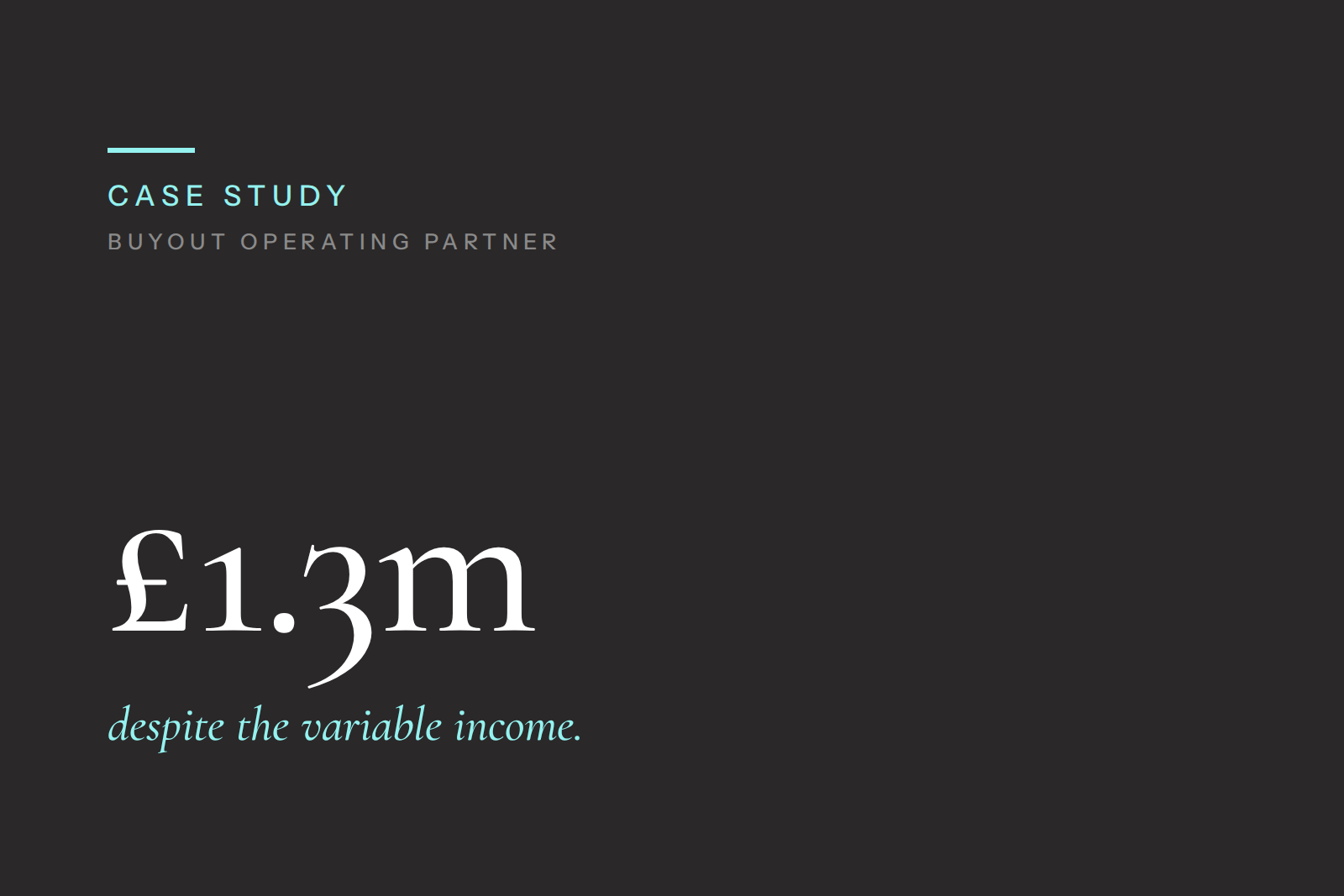
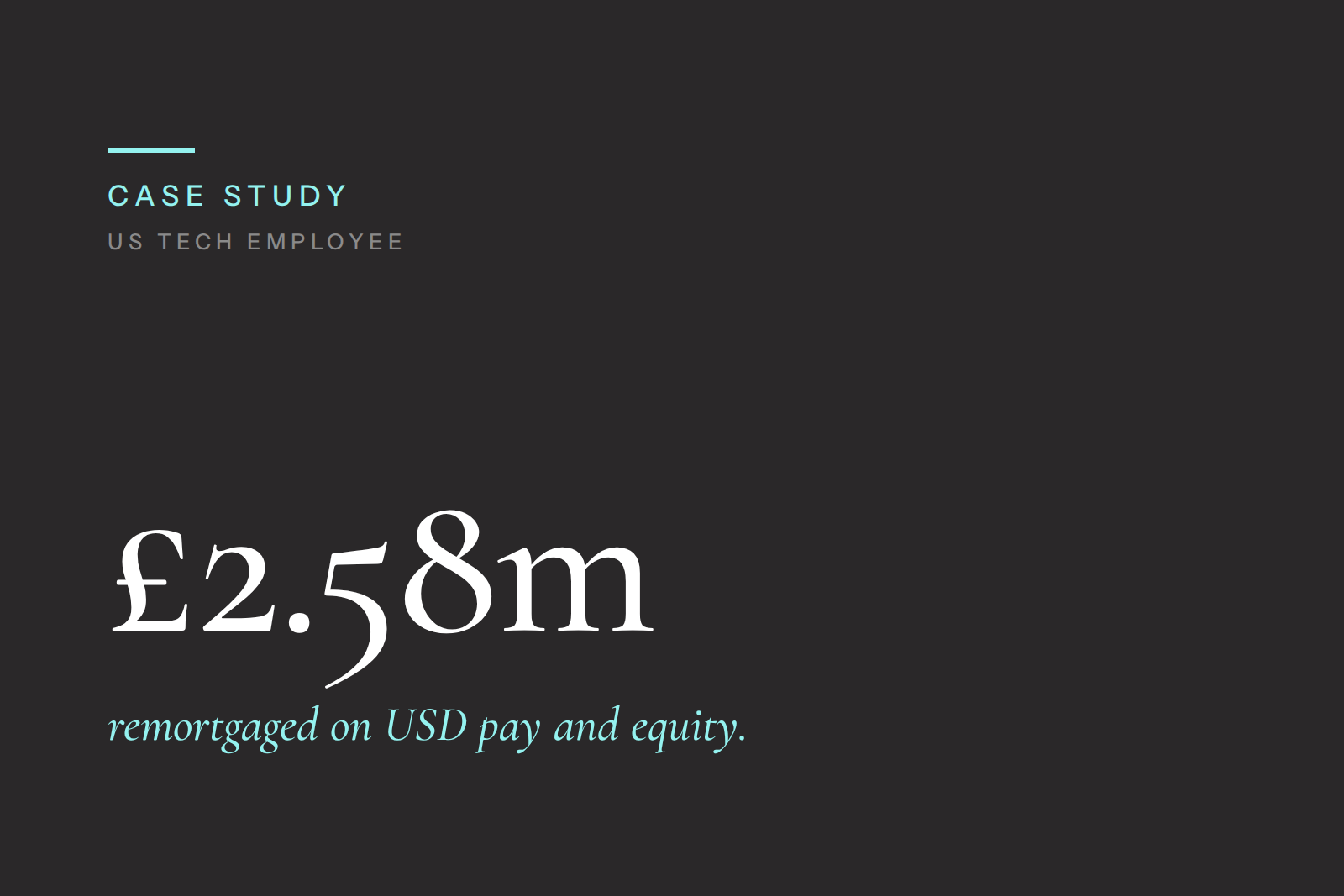
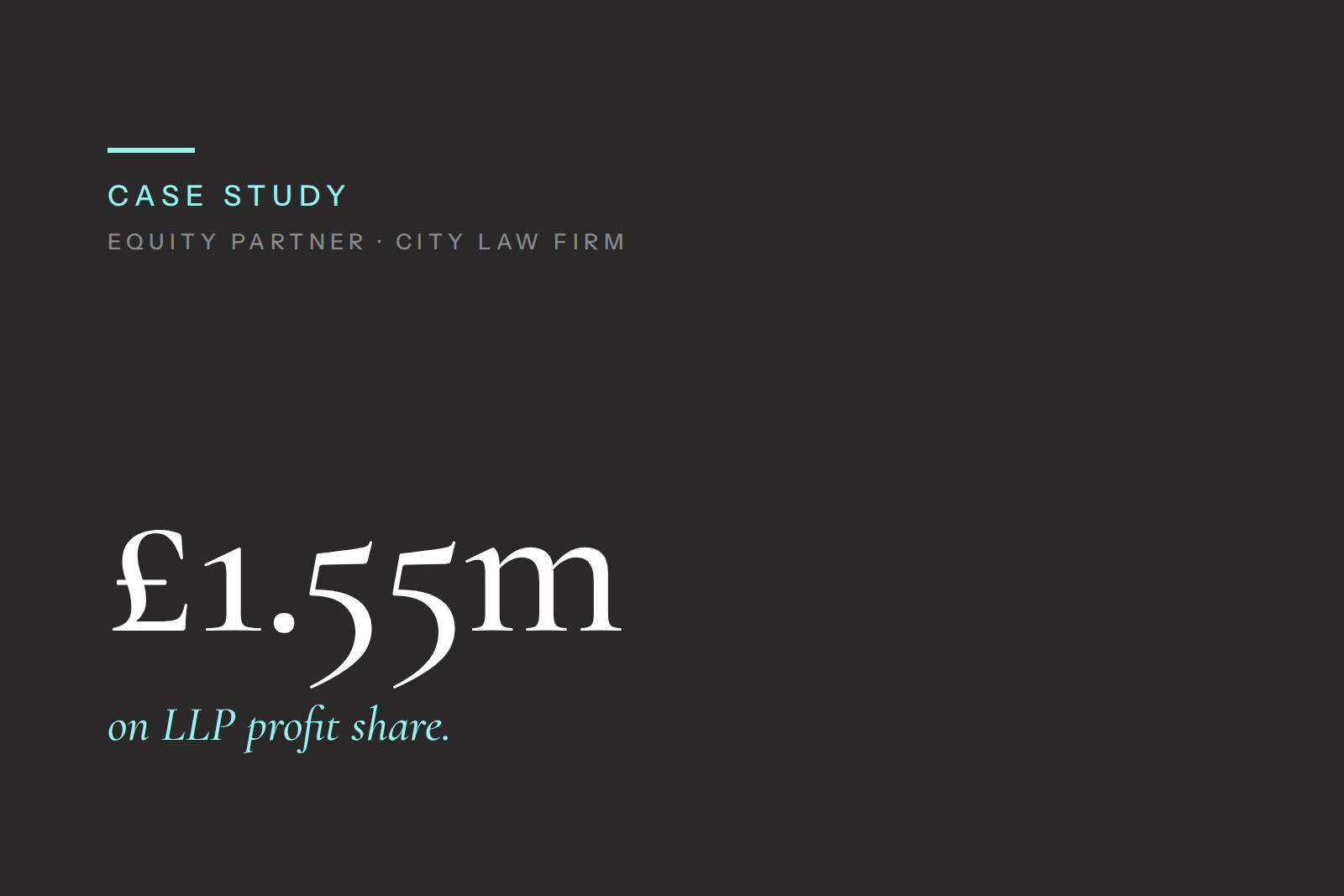
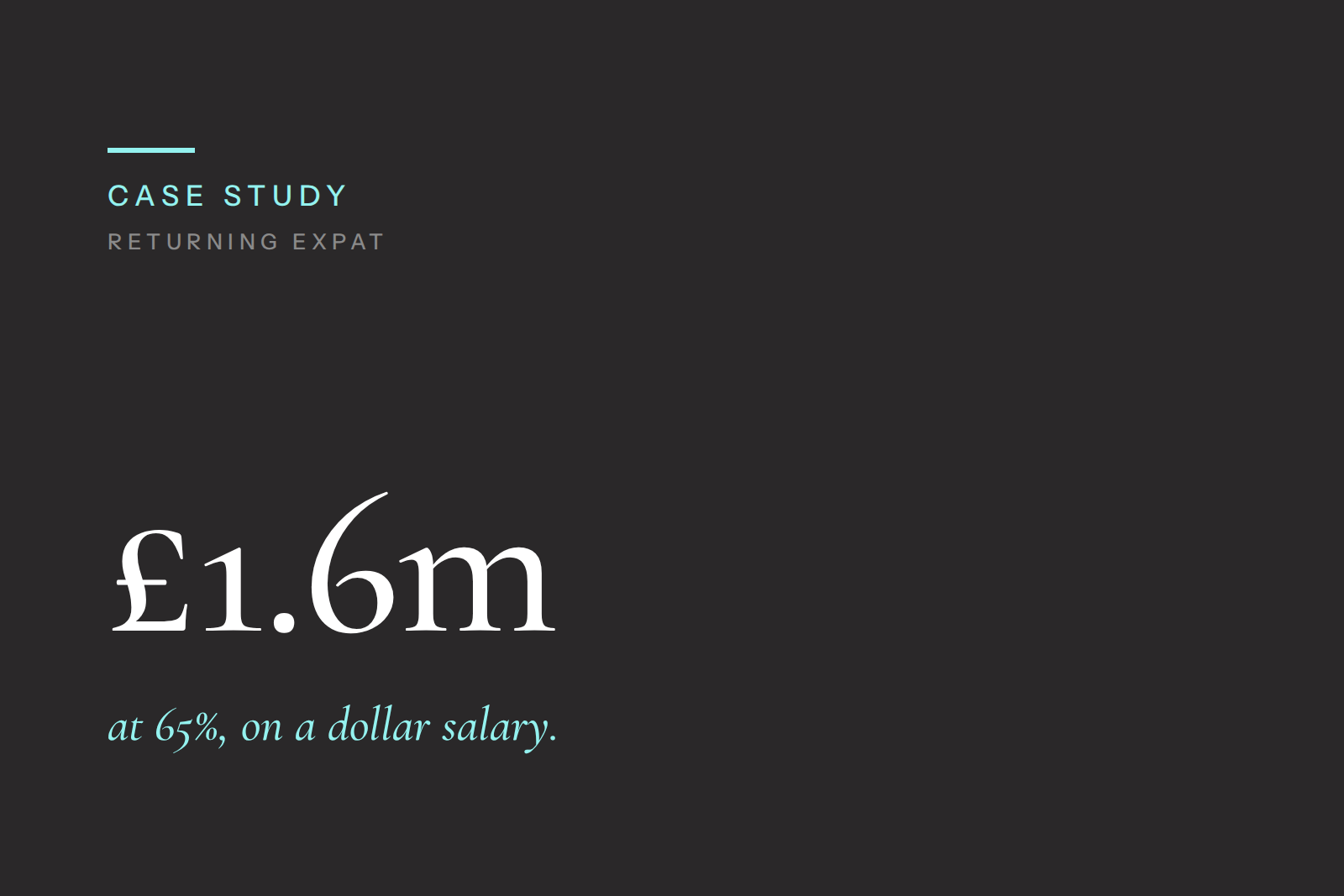
C A S E S T U D I E SHow we've helped clients with large loans


















F A Q sFrequently Asked Questions
-
In many cases, yes: several mainstream lenders offer enhanced income multiples of up to 5.5x for qualifying professional profiles, and some may stretch to 6x where overall affordability supports it. Private banks assess the whole picture rather than applying a fixed cap, so the effective multiple can be higher where assets and income stability are strong. The achievable multiple depends on your income structure, outgoings, credit profile and the property itself, which is what we model on the first call.
-
No: most large mortgages are placed with high street lenders through their dedicated large-loan teams. A private bank makes sense when you need flexibility the mainstream route cannot offer: very high LTV at scale, income that published criteria cannot capture, asset-based lending, full interest-only or a revolving facility. We start on the high street where the profile fits and show you both options where the case is close.
-
A 25% deposit (75% LTV) usually gives you more lender choice than higher LTVs; several mainstream lenders may lend to 85% at large loan sizes for qualifying profiles, and a few may consider 90% where income and credit are strong. On a £1.5m purchase that is £375,000 at 75% LTV (£1,500,000 × 25%) or £150,000 at 90% LTV (£1,500,000 × 10%). The right LTV for you depends on pricing at each band as much as on the deposit you have.
-
Yes, and how it is assessed makes a significant difference: some lenders average your last two years of bonus, others use the lower of the two, and some may accept 100% of the latest year with a track record. Because the counted share can range from half of the bonus to all of it, the same bonus can produce borrowing figures hundreds of thousands of pounds apart. We match your bonus profile to the lender that treats it most favourably.
-
It depends on the lender and the LTV. Most mainstream large-loan teams offer part-and-part, with the interest-only portion capped by LTV and tied to a documented repayment plan such as sale of the property with minimum equity, investments or pension, or bonus and profit share. Full interest-only on a large balance is less common on the high street and more often a private bank structure, again against a credible repayment plan.
-
Yes, though lenders may apply a haircut to foreign currency income, reducing the assessed figure by anything from nil to around 25% depending on the lender and the currency. Treatment varies widely between lenders and currencies, so the same overseas salary can support materially different borrowing depending on where the case is placed. We know which lenders on our panel treat each currency most favourably.
-
From full application to formal offer, most large-loan applications take three to six weeks with a mainstream lender. A private bank can be faster where the relationship already exists, and slower where the case needs credit committee approval. Having all documentation ready from the outset, including the source-of-funds trail, is the single biggest factor in keeping things on track.
-
Yes. Our fees are fixed and depend only on the complexity of your case, not on the size of the loan. Standard cases, which cover the majority of residential mortgages, are £750. Specialist cases, which involve additional structuring or documentation (for example foreign currency mortgages, equity compensation including Restricted Stock Units (RSUs), and expatriate or overseas mortgages), are £1,250. Whichever applies, the fee is payable in two stages: part on receipt of your mortgage offer and the balance on completion. Each payment is non-refundable once made. We also receive a commission from the lender, which will be shown on your mortgage illustration. We will tell you which fee applies, and when each part is payable, on our first call and confirm it in writing before any work begins. Existing Kite Mortgages clients pay no fee to remortgage their current home. Full details are on our fees page.
W H Y U S E A B R O K E RHow Kite Mortgages Structures Large Loans
We place large mortgages across a broad panel, from high street large-loan desks to private banks and specialist lenders. For each case we model affordability across several lenders, identify which route and structure gives the better outcome, and manage the application through to completion. At large loan sizes, lender selection and how the income is presented can be worth a great deal in additional borrowing or in interest saved over the term. That is what specialist placement means in practice.
Let's find the right route for your mortgage
Whether you are purchasing, remortgaging or exploring what is possible, we will outline the likely options, the numbers behind each route and the documents to prepare. No obligation, and the initial consultation is fee-free.