
T E C H & P R O D U C T L E A D E R S
Mortgage broker for tech professionals with RSUs, equity compensation, and complex remuneration
Whether you're a senior engineer at a US tech firm, a VP of Product buying your first London home, or a startup founder navigating self-employment rules, we understand how your income works — and which lenders treat it most favourably.
W H Y A S P E C I A L I S T B R O K E RWhy Tech Professionals Need a Specialist Mortgage Broker
You earn well. You'll probably be fine. That's what most senior tech professionals assume — and in many cases, they're right. But for a profession where a significant proportion of total compensation comes in equity rather than cash, the standard mortgage process can produce results that dramatically understate your actual earning power.
The problem isn't your income level — it's how that income is packaged. A senior engineer at a major tech firm might earn £120k base plus £80k in RSUs vesting annually, plus a £30k cash bonus. That's £230k of total compensation. But a mainstream lender that excludes equity income entirely will assess you on £150k. At 5x income, that's the difference between a £1.15m mortgage and a £750k mortgage — a gap of £400k in borrowing power, on the same total earnings.
Then there's the question of currency. Many tech professionals in London work for US-headquartered firms — Google, Meta, Amazon, Apple, Stripe, and others — and receive some or all of their compensation in US dollars. Add RSU vesting in USD-denominated stock, and you have an income profile that most generalist brokers simply aren't equipped to present to underwriters effectively.
We work with tech and product leaders across the career ladder — from senior engineers buying their first flat, to VPs and Directors upsizing to family homes, to CTOs and startup founders structuring large loans around complex compensation. We know the lender landscape for equity-heavy income, we've handled the RSU documentation dozens of times, and we can give you a clear answer on what's achievable, usually within the first call.
RSUs and mortgages — how equity compensation is really assessed →
Y O U R T E A M
David Walsh
Director & Mortgage Broker
Founder of Kite Mortgages. Specialist in complex income structures for City professionals. Advises on mortgage strategy for high earners with partnership income, bonus-heavy pay, equity compensation, and foreign currency earnings.
View profile →
Simon Hart
Mortgage & Protection Adviser
Mortgage adviser at Kite Mortgages. Specialises in high-value purchases and remortgages for City professionals. Works with clients navigating complex income structures including variable pay, carried interest, and multi-currency earnings.
View profile →I N C O M E A S S E S S M E N THow Lenders Assess Tech Professional Income
Senior Engineers and Individual Contributors
If you're employed on PAYE at a major tech firm, your base salary is straightforward — lenders take it at face value. The complexity comes from everything else: RSUs, cash bonuses, sign-on bonuses, and sometimes stock options or ESPP contributions.
RSUs are the biggest variable. Lenders are divided — some exclude them entirely, some include only vested and cashed RSUs averaged over 12 to 24 months, and a small number will take a broader view on upcoming vesting if the schedule is clear and the employer is well-known. The difference in treatment can be enormous: a senior engineer on £120k base with £80k of annual RSU vesting could be assessed on £120k by one lender and £180k+ by another.
What lenders typically want to see for RSU income: a track record of regular vesting (usually two to three years), evidence that vested stock has been sold and converted to cash, award grant letters showing the vesting schedule, brokerage statements showing vest and sale activity, and payslips or P60s that reflect the income. The stronger the paper trail showing consistent vesting and liquidation, the more comfortable the underwriter.
Cash bonuses at tech firms tend to be a smaller proportion of total compensation than in investment banking — but they still matter. Most lenders average cash bonuses over two years and use 50 to 100% of the average, depending on the lender. Sign-on bonuses are generally excluded as they're treated as one-off payments.
One thing we see regularly: tech professionals who've been told they "can't use RSUs" by a generalist broker, when the real answer is that the broker didn't know which lenders accept them or how to present the documentation. This is a solvable problem — it just requires knowing the lender landscape.
Engineering & Product Leaders
At VP and Director level — whether in engineering, product, design, or data — total compensation rises substantially, and the equity component typically grows as a proportion of the whole. It's not unusual for a VP of Engineering at a large tech firm to have a compensation package where RSUs represent 40 to 60% of total pay.
This creates a specific challenge: the higher your total compensation, the larger the gap between what you actually earn and what a conservative lender will assess. A VP earning £180k base with £200k in RSU vesting and a £40k cash bonus has total compensation of £420k. A lender that excludes RSUs and uses 50% of the cash bonus assesses income at £200k. At 5x, that's a £1m mortgage — on earnings that could support significantly more.
The best outcomes at this level come from lenders who have established frameworks for assessing equity compensation alongside salary and bonus. These lenders understand that a VP at a major listed tech company has a predictable compensation trajectory, even if the stock price fluctuates quarter to quarter. They assess the income on a sustainability basis — looking at the vesting history, the employer's track record, and the pattern of sell-to-cover or regular liquidation — rather than applying blanket exclusions.
If you've recently been promoted or changed firms, the picture can narrow. A new RSU grant at a new employer won't have a vesting history yet. In these cases, we typically structure the application around base salary and cash bonus initially, with RSU income added once the first vesting events are evidenced. Some lenders will accept the new grant letter alongside your historic track record at the previous firm if the role and sector are comparable.
CTOs, C-Suite, and Senior Executives
At CTO and C-suite level, compensation packages become more varied. You may have a combination of base salary, cash bonus, RSUs with multi-year vesting, stock options, long-term incentive plans, and potentially board fees or advisory income from other companies.
Lenders don't treat all of these equally. Base salary and cash bonus are the most straightforward. RSUs with a clear vesting track record can be included by the right lenders. Stock options are harder — most mainstream lenders exclude unexercised options entirely, though some private banks will consider them if they're deeply in the money and on a defined exercise schedule. LTIPs are typically excluded from mainstream affordability calculations.
At this level, we often see executives who've accumulated significant wealth through equity compensation but whose current assessed income doesn't reflect their actual financial position. A CTO who has £2m in vested stock, £500k in savings, and earns £300k base may find that their borrowing power on income alone is £1.5m — well below what their total financial picture could support.
This is where private banks can add genuine value. They'll look at the whole balance sheet — income, assets, investments, and equity holdings — rather than applying a rigid income-only model. For executives buying above £1.5m, a private bank may offer significantly more flexibility than the high street.
Startup Founders and Early-Stage Leaders
Startup founders present a distinct set of challenges. If you're the founder or early-stage CTO of a venture-backed company, your income profile is likely the opposite of a Big Tech employee: low base salary, minimal or no cash bonus, and significant equity that has no market value until a liquidity event.
The first question a lender will ask is whether you're employed or self-employed. This depends on your shareholding. Some lenders classify anyone with more than 20% equity in their company as self-employed; others use a 25% threshold. After funding rounds that have diluted your stake, you may have crossed below one of these thresholds without realising it — which can reclassify you as a PAYE employee and dramatically change how your income is assessed.
If you are classified as self-employed, most lenders will want two years of tax calculations (SA302s) and Tax Year Overviews showing your income from the business. If you've been paying yourself a minimal salary while the company reinvested in growth, those two years of low income are what the lender will use — regardless of what your salary is now, how much the company has raised, or what your equity stake is worth on paper.
The route through this depends on the specifics. If your shareholding is below the relevant threshold, we identify lenders that classify you as employed and assess you on current PAYE income — sometimes needing only one recent payslip. If you are genuinely self-employed, we look for lenders that will accept the most recent year of income (rather than averaging down with a lower prior year) or that will take a pragmatic view on salary increases backed by recent funding.
Equity in a private company is almost universally excluded from mortgage affordability. No mainstream lender will count unvested shares in an unlisted business, regardless of the implied valuation from your last funding round. Some private banks may consider it as part of a broader wealth assessment, but this is rare and typically only relevant at very high property values.
B O R R O W I N G P O W E RHow Much Can a Tech Professional Borrow?
Most tech professionals with clean credit and manageable outgoings can expect to borrow between 4.5 and 5.5 times their assessed income, with some lenders offering enhanced multiples of up to 6x for recognised professionals at certain income thresholds and LTV levels.
But as with every profession where variable or equity income is significant, the headline multiple matters less than what the lender counts as income. A 5x multiple on an assessed income of £150k (base + cash bonus only) gives you £750k. The same 5x on an assessed income of £230k — because the lender includes vested RSU income — gives you £1.15m. Same person, same employer, same total compensation, £400k difference in borrowing power.
This is why we never quote a headline multiple without running the affordability calculation through the specific lender's model. The real number depends on which income components the lender accepts, how they calculate them, and how their stress-testing model works.
M O R T G A G E S T R U C T U R E SStructures for Tech Professionals
Interest-Only for Tech Professionals
Interest-only can work well for tech professionals, particularly if you’re early in your career with a clear trajectory of rising compensation. Keeping monthly commitments low while your income grows — and using annual stock vesting or bonuses to make capital repayments — is a common and sensible approach.
Many lenders offer interest-only on the first portion of the loan, typically up to 75% LTV, with the remainder on repayment. This “part and part” structure is popular with our tech clients: it reduces monthly outgoings without requiring a full interest-only repayment strategy for the whole loan.
The catch: interest-only requires a credible repayment strategy. For tech professionals, this typically means demonstrating that future income, investments, or eventual property sale will cover the capital. Some lenders are more pragmatic than others about what they’ll accept.
Offset for Equity Vesting Cash Flows
If you’re holding substantial cash — from accumulated RSU sales, a sign-on bonus, or savings earmarked for a future tax bill — an offset mortgage lets you reduce the interest you pay without locking the money away. Your savings sit in a linked account and offset your mortgage balance, so you pay interest only on the net amount.
This is particularly useful for tech professionals who receive large lump sums when RSUs vest. Rather than choosing between paying down the mortgage or keeping the cash liquid, an offset gives you both: the interest saving of a lower balance, with full access to the cash if you need it.
The rate on an offset product is typically slightly higher than a standard fixed rate, but the net effect can be meaningful if you’re parking £50k to £200k alongside the mortgage across the year.
I N T E R N A T I O N A L P A YForeign Currency Income
A significant proportion of our tech clients work for US-headquartered firms and receive some or all of their compensation in US dollars. This might be base salary in USD, RSUs denominated in US-listed stock, or a mix of GBP salary with USD equity and bonus components.
Only a small number of UK lenders accept foreign currency income, and each applies a different "haircut" — a percentage reduction to account for exchange rate risk. These haircuts typically range from 10 to 25%, and the variation between lenders is significant. On a $250k total compensation package, the difference between a 10% haircut and a 25% haircut is $37.5k of assessed income — which translates to roughly £120k+ in borrowing capacity.
For tech professionals with mixed-currency compensation, we structure the application to maximise the proportion assessed in sterling. If your base is paid in GBP but RSUs vest in USD-denominated stock, presenting those components separately — and routing each to the lender that treats it most favourably — can produce a materially better result than bundling everything together.
We model affordability across all the major lenders that accept USD income, running parallel scenarios at different haircut levels so you know exactly where you stand before we submit anything.
L E N D E R S E L E C T I O N
Private Bank vs High Street
Our default position is the same as for all our clients: if it works with a mainstream lender, go mainstream. The rates and fees are lower. High street large-loans teams have become more sophisticated in how they handle equity compensation, and some now have established frameworks for RSU income — particularly where the employer is a well-known listed company.
Private banks come into play when mainstream options genuinely can't accommodate what you need. For tech professionals, that typically means one or more of: fully bespoke income assessment that considers unvested equity or stock options alongside salary, lending against assets rather than income alone (relevant for executives with significant accumulated wealth), interest-only on the full loan amount, or very high LTV at large loan sizes.
The premium is real. A private bank charging 0.5% more on a £1.5m mortgage costs you £7,500 a year in additional interest. Unless the flexibility justifies that premium — and for cases involving complex multi-currency, multi-component compensation at high loan sizes, it sometimes does — you're better off on the high street.
We'll always show you both options when both are viable. The right answer depends on the specific numbers, not on which route sounds more prestigious.
C A R E E R T I M I N G
Timing Your Mortgage Around Career Changes
Tech careers move fast. Job changes, promotions, IPOs, funding rounds, equity refreshes — each of these can affect how a lender assesses your income.
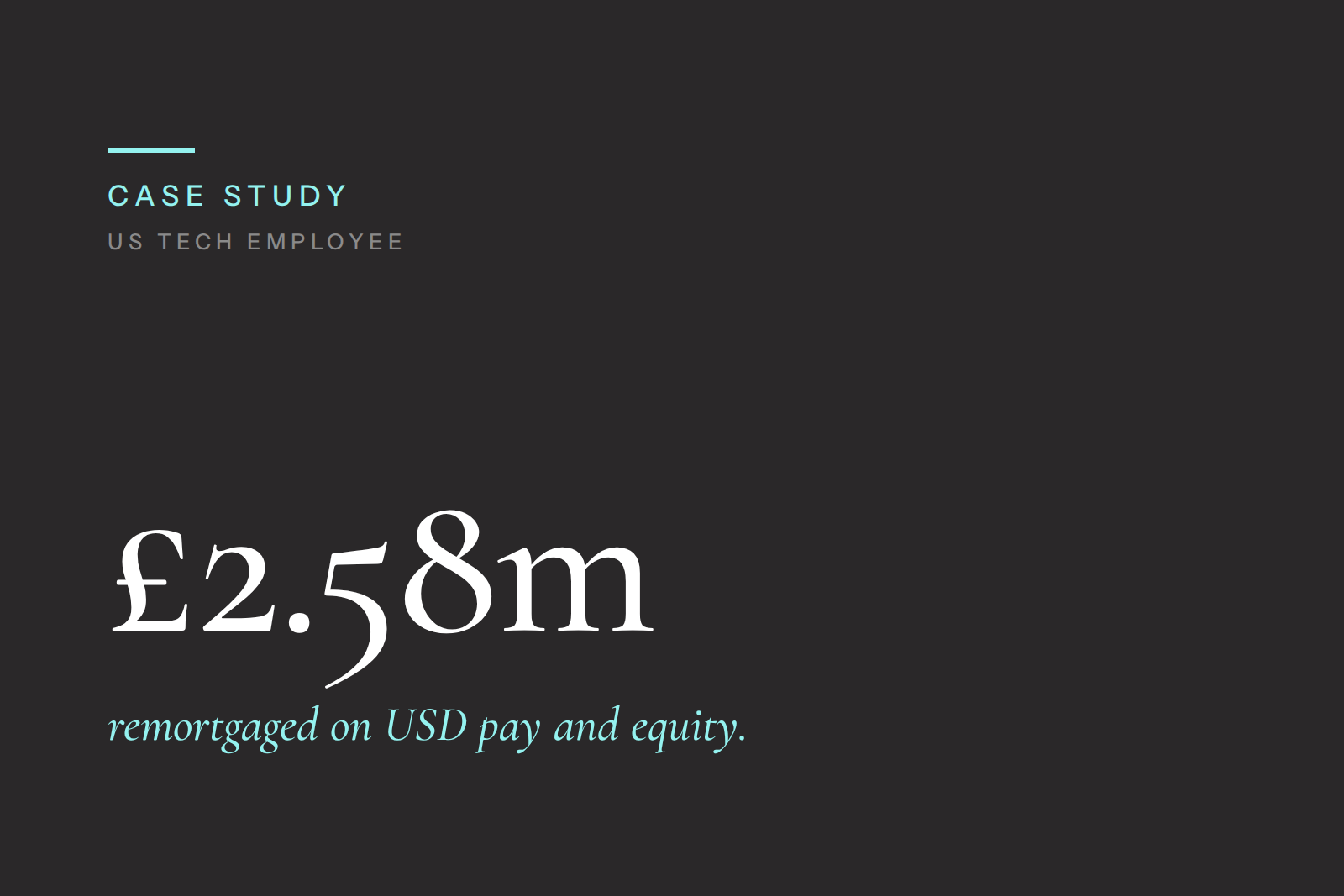
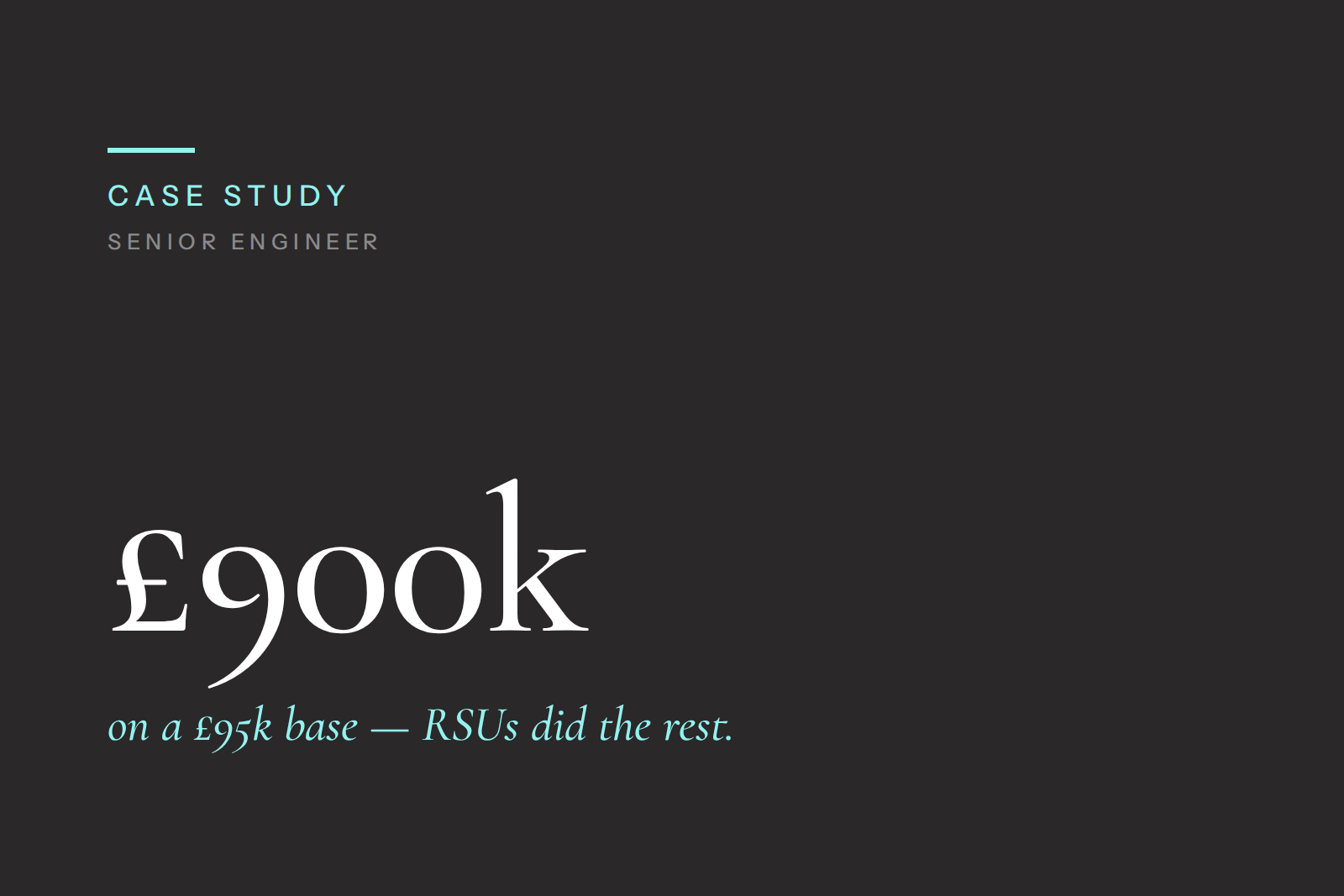
C A S E S T U D I E SHow we've helped tech and product leaders




R E L A T E D G U I D E S
Explore related guides
RSUs and Mortgages
How lenders really assess equity compensation — vested, unvested, and everything in between
Foreign Currency Income
For tech professionals at US-headquartered firms paid in USD
Interest-Only Mortgages
Part and part structures for professionals with rising compensation
Offset Mortgages
Reduce interest costs while keeping RSU vesting cash accessible
Do All Lenders Accept RSU Income?
Which lenders include RSUs and what they require
Protection for Professionals
Why employer cover leaves gaps — especially when changing jobs
A R T I C L E SArticles for tech and product leaders





F A Q sFrequently Asked Questions
-
Yes — but treatment varies dramatically between lenders. Some exclude RSUs entirely. Others include vested RSUs that have been sold and converted to cash, typically averaged over 12 to 24 months. A small number of lenders will take a broader view on upcoming vesting if the schedule is clear and the employer is a well-known listed company. The key factors are: how long you've been receiving RSUs, whether you've been regularly selling vested stock, and whether you can evidence the pattern with award letters, brokerage statements, and bank statements. We know which lenders accept RSU income and how to present it for the best outcome.
-
No. Many mainstream lenders still exclude RSUs from affordability calculations — particularly if the stock is unvested or hasn't been regularly sold. However, a growing number of lenders now have frameworks for assessing equity compensation, especially where the employer is a recognisable listed company with a track record of regular equity grants. The landscape is evolving, and what was excluded two years ago may now be accepted by specific lenders. We stay current on which lenders have updated their policies.
-
Expect to provide: award grant letters showing the full vesting schedule, confirmation of each vest (and sale where applicable), brokerage statements showing share movements and cash proceeds, bank statements evidencing the credits, employer compensation summaries, P60s, and recent payslips. The stronger the paper trail linking grant to vest to cash in your bank account, the more comfortable the underwriter. We'll tell you exactly what's needed after our first call.
-
Yes, but the route depends on your shareholding and income structure. If your equity stake has been diluted below certain thresholds (typically 20 or 25% depending on the lender), you may be classified as a PAYE employee — allowing you to borrow based on your current salary without needing two years of self-employed history. If you're classified as self-employed, lenders will typically want two years of tax calculations, which can be problematic if you've been paying yourself a minimal salary during the growth phase. We've helped multiple founders navigate this — it's about finding the right classification and the right lender.
-
Several UK lenders accept USD income, but each applies a different currency haircut — typically reducing the income they'll use by 10 to 25% to account for exchange rate risk. We work with all the major lenders that accept foreign currency income and know how to maximise what they'll count. For tech professionals with mixed-currency compensation — GBP base with USD RSUs, for example — we structure the application to maximise the sterling component and minimise the impact of the haircut.
-
Yes. Vested RSUs can be used as deposit evidence, though lenders will typically value them at a discount to current market price to account for potential price movements between application and completion. If you've already sold the stock and the cash is in your bank account, it's simply treated as savings — no discount applied. Unvested RSUs cannot be used as deposit evidence.
-
Our default is high street if it fits — the rates and fees are lower. Mainstream large-loans teams are now capable with RSU income, particularly for employees of well-known tech companies. Private banks make sense when you need flexibility that mainstream lenders can't offer: fully bespoke income assessment that considers unvested equity, lending against assets, or very large loans with complex multi-currency compensation. We'll always show you both options so you can make an informed comparison.
-
It can, particularly if RSU income is a significant part of your compensation. Your new employer's equity grant won't have a vesting history, so lenders that accept RSU income will typically fall back to your base salary and cash bonus until vesting begins. If you're planning a purchase, applying before you change jobs — while your current RSU track record is intact — can give you stronger borrowing figures. If you've already moved, we can often find lenders that will consider your combined track record across employers.
-
Typically between 4.5 and 5.5 times assessed income, with some lenders offering up to 6x for recognised professionals at certain income and LTV thresholds. The critical question is what the lender counts as income. A 5x multiple on £150k (base + cash bonus) is £750k. The same 5x on £230k (including vested RSUs) is £1.15m. We run the full calculation through lender-specific models to give you an accurate figure, not a headline.
-
We'll give you indicative figures the same day as our first call — usually within a few hours. Once we have your documents (typically P60s, payslips, RSU award letters, brokerage statements, and bank statements), we run a Decision in Principle within 24 hours.
-
Yes. Our fees are fixed and depend only on the complexity of your case, not on the size of the loan. Standard cases, which cover the majority of residential mortgages, are £750. Specialist cases, which involve additional structuring or documentation (for example foreign currency mortgages, equity compensation including Restricted Stock Units (RSUs), and expatriate or overseas mortgages), are £1,250. Whichever applies, the fee is payable in two stages: part on receipt of your mortgage offer and the balance on completion. Each payment is non-refundable once made. We also receive a commission from the lender, which will be shown on your mortgage illustration. We will tell you which fee applies, and when each part is payable, on our first call and confirm it in writing before any work begins. Existing Kite Mortgages clients pay no fee to remortgage their current home. Full details are on our fees page.
C L I E N T R E V I E W S
What our clients say
H O W I T W O R K SFour steps to your mortgage
01
Initial call
A 30–40-minute conversation to understand your situation, income structure, and what you’re looking to do. We’ll give you indicative figures the same day.
02
Documents & DIP
We tell you exactly what we need — typically P60s, payslips, RSU award letters, vesting schedules, brokerage statements, and bank statements. Once received, we run a Decision in Principle within 24 hours.
03
Application & management
We handle everything from full application through to completion — managing the lender, chasing solicitors, updating your agent, and keeping you informed throughout.
04
Ongoing monitoring
We check rates on all live cases every two weeks. If a better deal becomes available before completion, we’ll flag it. After completion, we’ll contact you before your deal expires to review your options.
We also review your protection needs alongside the mortgage. Many tech professionals have employer-provided life cover and income protection, but these typically lapse if you leave the firm — and in a sector where job changes are frequent, that gap can appear quickly. We’ll highlight where your employer cover falls short and give you the option to put personal protection in place.