
E X P A T M O R T G A G E S
Expat mortgages in the UK: how residency, credit history, and timing affect your application — and what lenders actually need
You earn well, you have a strong deposit, and you know where you want to live. But if you've spent time overseas — or you're still there — UK mortgage lenders don't assess you the same way as a straightforward domestic applicant. How long you've been away, where your income is paid, whether you've maintained a UK credit footprint, and when you plan to return all change which lenders will consider your application and on what terms.
Y O U R T E A MYou'll speak with a broker who structures expat and returning-professional applications every week

David Walsh
Director & Mortgage Broker
Founder of Kite Mortgages. Specialist in complex income structures for City professionals. Advises on mortgage strategy for high earners with partnership income, bonus-heavy pay, equity compensation, and foreign currency earnings.
View profile →
Simon Hart
Mortgage & Protection Adviser
Mortgage adviser at Kite Mortgages. Specialises in high-value purchases and remortgages for City professionals. Works with clients navigating complex income structures including variable pay, carried interest, and multi-currency earnings.
View profile →T H E K E Y D I S TI N C T I O NWhich Expat Scenario Applies to You?
The word "expat" covers several very different mortgage situations, and lenders treat them differently. The right approach — and the right lender — depends on which of these describes your position.
Returning British Expat
You’re a UK national who’s been working overseas and you’re moving back. You may already have a UK job offer, or you’re planning to continue remote work for an overseas employer. Lenders typically require you to be back within six months.
View guide →
Non-Resident Buying from Overseas
You’re based overseas with no immediate plans to return, but you want to purchase UK property. Deposit requirements are typically 25%+, and lender options are more limited.
Foreign National in the UK
You’ve moved to the UK on a skilled worker visa, spouse visa, or other route. You may have limited UK credit history, but your residency and income are here. Lender criteria focus on time in the UK, visa remaining, and deposit.
View guide →
Dual-Resident / Split Life
You live between two countries — perhaps your family is in London while you work in Zurich, Singapore, or New York. Lender assessment depends on residency classification, income currency, and primary residence status.
These aren't rigid categories. Many clients sit between two. The point is that "expat mortgage" is not a single product — it's a set of lender policies that vary by nationality, residency status, income structure, credit history, and timeline.
A P P L I C A T I O N T I M I N G
Pre-Arrival vs Post-Arrival: When Should You Apply?
This is one of the most common questions we're asked, and the answer shapes everything that follows.
See our step-by-step preparation timeline for returning buyers →
Applying After You Return
Once you're back in the UK and earning in sterling — or at least UK-resident and on payroll — the number of available lenders increases substantially. Most high street banks will treat you as a standard UK applicant from day one of return, provided you can evidence income and pass credit scoring.
The key variable is your UK credit footprint. If you've maintained bank accounts, a registered UK address, and some form of credit activity during your time overseas, scoring should be straightforward. If you've been away for several years with no UK financial activity, some lenders' automated systems may decline you — not because of bad credit, but because of no credit.
The Decision Framework
The right choice depends on three things:
Your timeline — if you need to move quickly and can't afford months of renting, pre-arrival may be worth the trade-off of fewer lender options. If you have flexibility, waiting gives you access to more competitive rates.
Your income structure — if your income will be paid in GBP once you start your UK role, waiting means no currency haircut. If it will remain in foreign currency, the timing matters less.
Your credit position — if you've maintained a UK credit footprint, you'll likely pass scoring from day one. If not, a pre-arrival application through a lender with manual underwriting may actually be easier than trying to pass an automated score.
C R E D I T & S C O R I N G
Credit History, Scoring, and the UK Footprint Problem
This is where most expat applications either succeed smoothly or hit an avoidable wall. It's not about good credit or bad credit — it's about whether you have enough UK credit data for lenders to make a decision.
Why Credit Scoring Matters More Than You'd Expect
UK mortgage lenders use credit scoring as part of their initial assessment, based on your UK credit file over the past six years. If you've been overseas for three, five, or ten years with minimal UK financial activity, your credit file may be effectively blank.
This isn't the same as bad credit — you haven't missed any payments. But from the lender's automated system, a thin file and a problematic file can produce the same result: a decline.
How to Maintain or Rebuild a UK Credit Footprint
If you're still overseas and planning to return:
Keep at least one UK bank account open and active. Even minimal transactions maintain a visible record of UK financial activity.
Stay on the electoral roll at a UK address. This is one of the strongest signals for credit scoring. If you have a family member's address you can use, registering there significantly improves your position.
Keep one UK credit product active. A credit card with a small balance paid off monthly demonstrates responsible credit management on a UK file, even while you're overseas.
If you've already left without doing any of this, the footprint can be rebuilt — but it takes time. Start as early as possible, ideally six to nine months before you plan to apply.
What If You Have No UK Credit History At All?
This applies primarily to foreign nationals who've never lived in the UK, or British nationals who left very young. The options are: lenders with manual underwriting, private banks who don't use automated scoring, or building a short UK credit history (three to six months of activity is enough for some lenders).
L E N D E R A S S E S M E N T
How Lenders Assess Expat Mortgage Applications
Beyond credit scoring, lenders evaluate several factors specific to expat and internationally mobile applicants.
Residency Status and Right to Reside
For British nationals returning, your nationality gives you the right to reside, and lenders simply need evidence that you're returning within their policy window (usually six months).
For foreign nationals, the assessment depends on visa type and remaining duration. Most lenders require 12 to 18 months remaining. Some require indefinite leave to remain. Others will accept shorter durations if income and deposit are strong.
Foreign national mortgages: full guide →
Income Assessment
How your income is assessed depends on where you're employed, what currency you're paid in, and whether the income will continue after relocation. If you're returning to GBP employment, assessment is standard. If your income is in foreign currency, lenders apply a haircut of 10% to 25%.
Foreign currency income mortgage: haircuts, lender policies, and how to maximise borrowing →
If you're self-employed — either continuing an overseas business or starting fresh — most lenders want two years of accounts. Exceptions exist for qualified professionals joining established partnerships.
Deposit and LTV
For returning expats who will be UK-resident at completion, standard LTV limits apply — as low as 5% to 10% deposit. For non-resident borrowers purchasing from overseas, most lenders require a minimum 25% deposit.
The source of your deposit matters. If funds are held overseas, lenders need a clear audit trail — bank statements, evidence of transfer, and exchange rate documentation.
Dual Residents and Split-Life Arrangements
If you live between two countries, lender assessment depends on where you're deemed to be resident for mortgage purposes — not necessarily the same as tax residency. Some lenders will treat you as UK-resident if the property is your family's primary home; others will classify you as non-resident.
L E N D E R R O U T E S
Lender Routes for Expat Mortgages
Not all lenders treat expat applications the same way, and the route you take affects your rate, borrowing power, and processing speed.
High Street Lenders
Several high street banks have specific policies for returning expats and foreign nationals. Competitive rates, standard products — but more rigid criteria. Automated credit scoring, minimum residency periods, and specific visa requirements. If you fit, this is usually the best route on rate.
Private Banks
For loans above £1m, complex residency situations, or cases where automated scoring will fail, private banks use manual underwriting and assess applications holistically. The trade-off is cost — higher rates, arrangement fees, and sometimes a relationship expectation.
Private bank mortgages: when bespoke underwriting is worth the premium →
International Lenders
A small number of international banks focus on cross-border lending. Useful for non-resident purchases or complex multi-jurisdiction situations, but typically more expensive. We explore UK routes first and only recommend international lenders when domestic options genuinely don't fit.
D O C U M E N T R E Q U I R E M E N T SDocuments You'll Need for an Expat Mortgage Application
In addition to the usual income and identity evidence, lenders need to verify your residency status, deposit source, and right to reside.
Identity & Residency
Valid passport and second form of ID
Driving licence or national identity card — some lenders require two forms
Visa or BRP card (foreign nationals)
Showing visa type, expiry date, and any conditions — lenders check remaining duration against their minimum
Proof of UK address
Utility bill, council tax bill, or bank statement at your UK address — dated within the last 3 months
Proof of overseas address (if currently non-UK-resident)
Utility bill or official correspondence at your current overseas address
Evidence of planned return (pre-arrival applications)
UK employment contract, signed offer letter with start date, or relocation documentation from your employer
Income
UK payslips (if already in UK employment)
Most lenders want the latest 3 months — including any that show bonus or variable pay
UK employment contract or offer letter
Required if starting a new UK role — some lenders accept contracted salary before your start date
Overseas payslips and employment contract
Last 3–6 months — required if income is paid overseas or in foreign currency
SA302 tax calculations and tax year overviews (self-employed)
Last 2 years minimum — primary evidence for self-employed or partnership income
Company accounts (if self-employed through a limited company)
Last 2 years — some lenders use salary plus net profit rather than dividends drawn
Deposit & Funds
UK bank statements showing deposit funds
Last 3–6 months — showing the accumulation or receipt of your deposit savings
Overseas bank statements (if deposit held abroad)
With evidence of how funds were accumulated — lenders need a clear audit trail from overseas account to UK solicitor
Foreign exchange confirmation
Evidence of the currency conversion if transferring deposit from overseas — the exchange rate at point of transfer is what counts
Gift letter (if deposit includes a gift)
Confirming the gift is non-repayable, with the donor’s bank statements showing the source of funds
Credit & Address History
Six-year UK address history
Including any overseas addresses during that period — lenders need a complete timeline
Overseas credit report (if available)
Some lenders accept US, Australian, or other international credit data to supplement a thin UK file
Electoral roll confirmation
If registered at a UK address — one of the strongest signals for UK credit scoring
W H O T H I S A P P L I E S T OExpat Mortgages by Profession
Expat and internationally mobile professionals come from every sector we work with. The residency and credit challenges are shared — the income complexity varies by profession.
Lawyers & Law Firm Partners
Partners at US-headquartered firms relocating back to London. Associates transferring between international offices. LLP income, partnership buy-ins, and profit share structures that need specialist lender treatment on top of the expat criteria.
View guide →
Investment Banking Professionals
Bankers returning from New York, Hong Kong, or Singapore. USD or HKD bonuses, deferred compensation, and sign-on packages that lenders assess differently depending on the currency and the structure.
View guide →
Private Equity Professionals
PE professionals returning from offshore fund roles or secondments. Carried interest, co-investment returns, and base-plus-carry structures that most lenders don’t know how to underwrite — compounded by the residency question.
View guide →
Hedge Fund Professionals
Portfolio managers and senior analysts relocating between London, New York, and Asia. Performance fees, fund returns, and deferred compensation paid across multiple currencies and tax jurisdictions.
View guide →
Trading & Investment Professionals
Traders and structurers moving between global desks. Bonus-heavy income with year-on-year volatility, often paid in the currency of the desk location. Variable income and foreign currency create a double underwriting challenge.
View guide →
Tech & Product Leaders
CTOs, VPs, and engineering directors transferring from European or US headquarters. RSU vesting schedules denominated in USD or EUR, base salary in a different currency, and split-life arrangements between London and another city.
View guide →
R E L A T E D G U I D E S
Explore related guides
Foreign Currency Income Mortgages
How lenders convert and discount non-GBP income — haircuts, accepted currencies, and lender-by-lender policies
Large Mortgage Loans
Routes to borrowing above £1m via high street large-loan teams and private banks — relevant for most expat professionals buying in London
Private Bank Mortgages
When bespoke underwriting is worth the premium — particularly relevant for non-standard residency profiles or thin UK credit files
Interest-Only for High Earners
When interest-only makes sense as part of a broader wealth strategy — often used alongside expat mortgages for higher-value properties
Bonus Income Mortgages
How lenders treat annual and quarterly bonuses — critical for expat professionals whose bonus is the largest component of pay
Equity Compensation & RSU Mortgages
RSUs, stock options, and deferred equity awards — how lenders assess non-cash compensation, relevant for tech and finance professionals relocating
A R T I C L E SArticles on expat and returning-professional mortgages




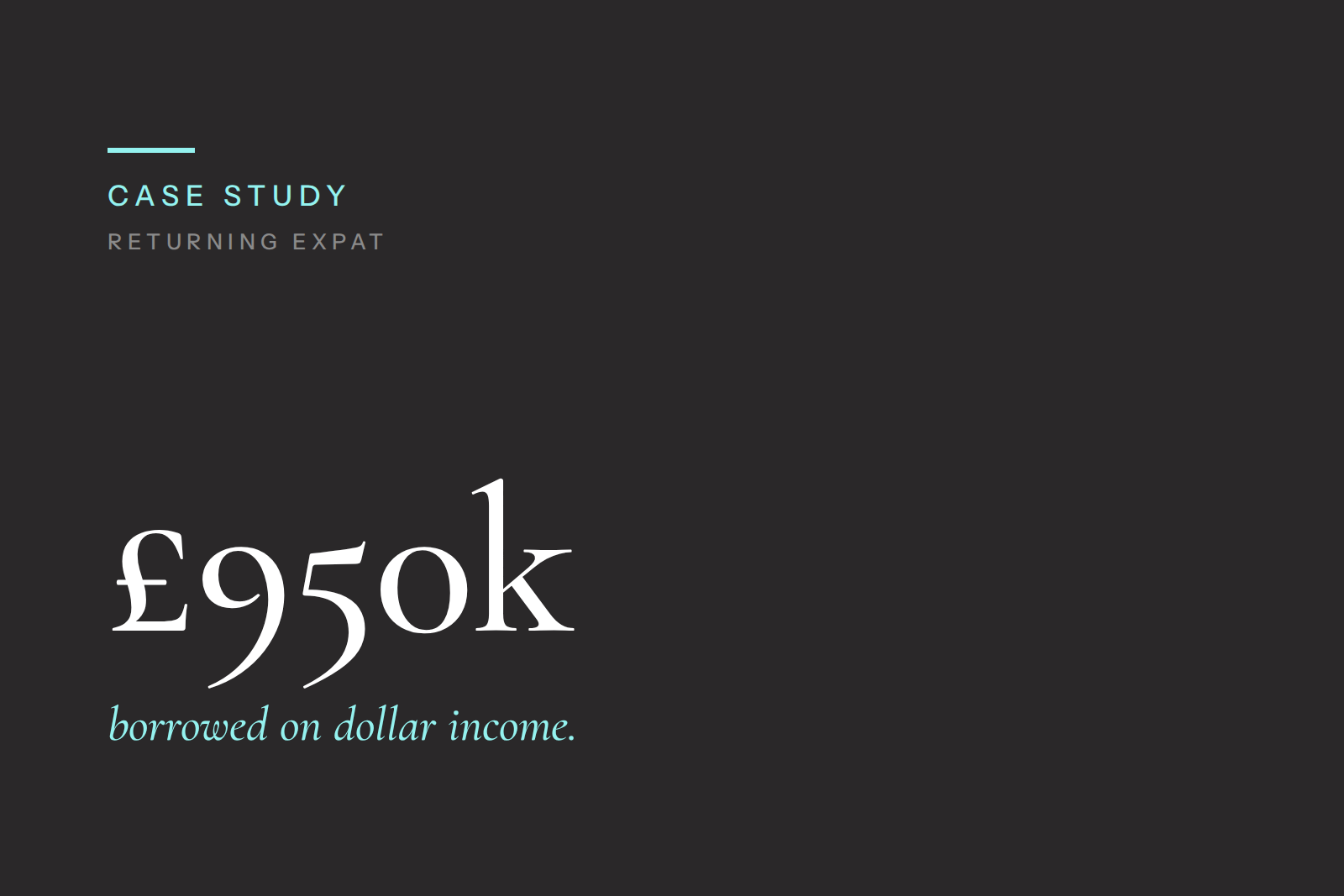
C A S E S T U D I E SHow we've helped expat and internationally mobile clients




F A Q sFrequently Asked Questions
-
Yes. Several UK lenders offer mortgages to expats — both British nationals returning to the UK and foreign nationals already here. The specific options depend on your residency status, how long you've been in the UK (or how soon you're returning), your income structure, and your credit history. Returning British expats who will be back within six months can often apply pre-arrival. Foreign nationals on skilled worker or other eligible visas can access standard mortgage products, though criteria vary by lender.
-
Yes, if you're a UK national returning within approximately six months. Some lenders have specific pathways for pre-arrival applications, typically requiring evidence of the planned return — such as a UK employment contract or signed offer letter. Fewer lenders offer this route compared to post-arrival, which means your options on rate and product may be narrower. However, it allows you to complete on a property before you arrive, avoiding the cost and disruption of interim rental.
-
It depends on whether you'll be UK-resident at completion. Returning expats who will be living in the UK are generally subject to the same deposit requirements as any domestic applicant — often as low as 5% to 10%, though larger loans typically require 15% or more. Non-resident borrowers purchasing from overseas usually need a minimum 25% deposit. If your deposit is held in a foreign currency overseas, you'll need to evidence the transfer and conversion clearly.
-
A thin or absent UK credit file doesn't mean you can't get a mortgage — but it does mean lender selection matters. Some lenders use manual underwriting rather than relying solely on automated credit scoring, which allows them to assess your application on documents and overall financial strength. Private banks don't use automated scoring at all. You can also rebuild a UK credit footprint relatively quickly: opening a UK bank account, registering on the electoral roll, and maintaining a credit card with small regular payments for three to six months can be enough for many lenders.
-
Not always. If you're returning to the UK with a confirmed employment contract that starts within a set window (often up to three months), some lenders will accept that as income evidence. If you're continuing to work for an overseas employer after returning, lenders need to be satisfied that the income is sustainable and the arrangement is credible. If you're returning without employment lined up, you'll generally need to secure a role before a lender will assess your affordability — a signed offer letter with a start date is usually sufficient.
-
There's no universal minimum. Some lenders will consider returning expats from day one of arrival. Others prefer one to three months of UK payslips. A smaller number require six to twelve months of UK residency — but these are in the minority and typically avoidable with the right lender. For foreign nationals, the period of UK residency is one of several factors — alongside visa type, remaining visa duration, income, and deposit — that determine which lenders are available.
-
Lenders will typically convert your income to sterling and apply a haircut — usually between 10% and 25% — to account for exchange rate fluctuation. The size of the discount varies by lender and by currency (USD and EUR are most widely accepted; less common currencies may face larger haircuts or fewer lender options). This applies whether you're still overseas or already in the UK but paid in non-sterling. Our foreign currency income guide covers the mechanics in detail, including which lenders offer the smallest haircuts.
-
Not necessarily — and this is a common misconception. If you're a returning British expat being assessed as a UK resident, you'll access the same product range and rates as any domestic borrower. If you're a non-resident purchasing from overseas or your profile requires a private bank or specialist lender, rates may be higher — but this reflects the lending route, not your expat status specifically. The goal is to place you on the most competitive route your profile supports.
-
An expat mortgage involves more variables than a standard application — residency criteria, credit scoring thresholds, foreign currency policies, deposit source requirements, and pre-arrival eligibility all vary by lender. Applying directly without knowing which lenders suit your profile risks unnecessary declines and hard credit searches that can damage your score. A broker who works with expat applications regularly knows which lenders to approach for your specific situation, what documents to prepare, and how to position the application to avoid common friction points.
W H Y U S E A B R O K E RHow Kite Mortgages Helps With Expat Mortgages
We structure expat and returning-professional applications every week. We know which lenders accept pre-arrival applications and what evidence they need. We know which high street banks will assess you from day one of return and which require a waiting period. We know which private banks are worth the premium for non-standard residency profiles and which are an unnecessary cost.
We'll review your residency position, income structure, credit history, and timeline — then tell you which lender route delivers the strongest outcome. If you're still overseas, we'll map out a preparation plan so you're ready to move quickly when the time comes. If you're already in the UK, we'll identify the fastest path to a completed mortgage with the best available terms.