
C O N T R A C T O R M O R T G A G E S
Contractor mortgage daily rate: how lenders annualise your day rate and what it means for borrowing
If you're a senior IT contractor, management consultant, or interim executive earning £500–£1,500 a day through your own limited company, most high street brokers will tell you to wait for two years of accounts. They're wrong — or at least, they're not telling you the whole picture. A growing number of lenders will annualise your day rate directly, and the difference in borrowing power can be substantial. We know which lenders use day rate annualisation, how each one calculates it, and how to present your case so you borrow the maximum your contract supports.
Y O U R T E A MYou'll speak with a broker who structures contractor mortgage applications for City professionals every week

David Walsh
Director & Mortgage Broker
Founder of Kite Mortgages. Specialist in complex income structures for City professionals. Advises on mortgage strategy for high earners with partnership income, bonus-heavy pay, equity compensation, and foreign currency earnings.
View profile →
Simon Hart
Mortgage & Protection Adviser
Mortgage adviser at Kite Mortgages. Specialises in high-value purchases and remortgages for City professionals. Works with clients navigating complex income structures including variable pay, carried interest, and multi-currency earnings.
View profile →W H O T H I S A P P L I E S T O
The Contractors We Work With — and Why Standard Advice Falls Short
This page isn't about zero-hours workers or agency temps. The contractors we work with are senior professionals who've chosen to contract for flexibility, autonomy, or tax efficiency — and who earn accordingly.
The most common profiles among our clients:
Senior IT and Technology Contractors
Software engineers, architects, DevOps leads, data engineers, and CTOs operating through their own limited companies. Day rates of £500–£1,500 are standard at this level. Many have been contracting for years; others have recently moved from permanent roles at firms where they were earning well into six figures. Either way, lenders who insist on two years of company accounts are missing the point — your contract is the evidence of your earning capacity, not your corporation tax return.
See our dedicated guide for senior tech and product leaders →
Management Consultants and Interim Executives
Independent consultants — often Big 4 alumni or former partners — who contract directly with clients or through specialist consultancy placement firms. Interim CFOs, COOs, transformation directors, and programme leads working on six- to twelve-month engagements. Income is strong but irregular: a £1,200/day engagement might run for nine months, followed by a two-month gap before the next one starts. Lenders need to see through the gaps to the underlying earning pattern.
Finance and Professional Services Contractors
Contractors in banking operations, compliance, risk, legal, and accounting. Often working inside major financial institutions on a day-rate basis through personal service companies. These are professionals doing the same work as their permanently employed colleagues, often sitting at the same desks — but paid differently, and therefore assessed differently by mortgage lenders.
See our dedicated guide for investment banking professionals →
H O W L E N D E R S A S S E S Y O U
Day Rate Annualisation vs Company Accounts — the Fork That Determines Your Borrowing
This is the single most important thing to understand about contractor mortgages: there are two fundamentally different ways a lender can assess your income, and the route you take changes how much you can borrow — sometimes by hundreds of thousands of pounds.
Route One — Company Accounts (Self-Employed Assessment)
Some lenders treat all Ltd company contractors as self-employed. They ask for two years of company accounts or SA302 tax calculations, and they assess your income as salary plus dividends — often averaging the last two years, sometimes using the lower of the two.
If you draw a modest salary of £12,570 and take £40,000 in dividends, your assessable income under this method is £52,570. At 4.5× that's a maximum borrowing of approximately £237,000. For a contractor earning £800 a day, that figure bears no relation to your actual earning capacity. It's an artefact of how you've structured your tax affairs, not a reflection of what you earn.
Route Two — Day Rate Annualisation
A growing number of lenders will look at your contract day rate and annualise it directly. The standard formula is:
Day rate × 5 days × 46 weeks = annual income
So at £800/day: £800 × 5 × 46 = £184,000 annualised income. At 4.5× that's a maximum borrowing of approximately £828,000 — more than three times the accounts-based figure, from the same person earning the same money.
Why the Day Rate Figure Is Usually Higher
Most contractors who operate through limited companies draw a tax-efficient combination of low salary and dividends. The rest sits in the company as retained profits. That's sensible tax planning, but it means company accounts dramatically understate your true earning capacity.
Day rate annualisation cuts through this. It asks: what does this person actually earn per day, and what would that look like over a full working year? For the vast majority of contractors we work with, the annualised day rate produces a significantly higher — and more representative — income figure.
The 46-week assumption builds in six weeks for holidays and gaps between contracts. Some lenders use 48 weeks; a few use different multipliers. The variation between lenders is another reason why which lender you apply to matters enormously.
When Accounts Might Be Better
It's not always clear-cut. If you've had a particularly strong year — perhaps you retained substantial profits in the company, or your latest SA302 shows income well above your day rate equivalent — an accounts-based assessment using the latest year could produce a higher figure. This is unusual, but it happens. We model both routes and advise on which gives you the strongest position.
M I N I M U M H I S T O R Y & G A P S
How Long Do You Need to Have Been Contracting?
This is where contractors get the most conflicting advice. The answer depends on the lender, but there's more flexibility than most brokers realise.
The 12-Month Standard
Most lenders that offer day rate annualisation want to see at least 12 months of contracting history in your current field. That doesn't have to be continuous — gaps are expected — but they want evidence of a sustained pattern of contract work.
Some lenders count the total contract period, not just time worked. If you've been on a contract for three months with nine months remaining, that's 12 months total — and some lenders will accept that from day one.
Six Months — or Even Less
A smaller number of lenders will consider contractors with as little as six months of experience, provided the overall profile is strong: a solid day rate, a current contract with reasonable remaining term, and — ideally — a background in the same industry as a permanent employee before you started contracting.
If you've moved from permanent to contract work with the same employer — you were a permanent software engineer at a firm, and now you contract back to them — some lenders will use your day rate income immediately, with no minimum contracting history at all. The logic is straightforward: the employer clearly values your work enough to hire you back at a premium.
Gaps Between Contracts
Gaps are a normal part of contracting. Lenders understand this — but they have different tolerance levels.
Most lenders that use day rate annualisation are comfortable with gaps of up to four to six weeks. These are treated as standard between-contract breaks and don't need much explanation beyond a timeline of your contracts showing the gap.
Gaps of six to eight weeks require a bit more context. A brief explanation — contract ended, you took a holiday, started the next engagement — is usually sufficient if the overall pattern of contracting is strong.
Longer gaps need careful handling. A three-month break might prompt a lender to pro-rate your annualised income, reducing the figure. Or it might not, if you can demonstrate it was a one-off — parental leave, a planned career break, a relocation — rather than a sign of inconsistent work flow.
The key is documentation. We provide lenders with a contract timeline showing every engagement, start and end dates, day rates, and a brief note on any gaps. This turns what might look like an irregular employment history into a clear narrative of sustained professional contracting.
I R 3 5 & C O N T R A C T O R S T R U C T U R E SIR35, Ltd Companies, and How Your Structure Affects Lender Treatment
How you're set up as a contractor — Ltd company, umbrella, PAYE — directly affects how lenders assess your income. And IR35 status adds another layer that many brokers don't fully understand.
Outside IR35 — Ltd Company (PSC)
This is the most common structure among our clients. You operate through your own personal service company, invoice your clients (or an agency), and draw a combination of salary and dividends. For mortgage purposes, lenders will either treat you as self-employed (accounts route) or as a day rate contractor (annualisation route). The goal is to secure the annualisation route wherever possible, because it almost always produces a higher income figure.
Documentation typically includes your current contract, evidence of renewals or extensions, three to six months of business and personal bank statements, invoices and remittance advice, and — if accounts exist — your SA302s and tax year overviews. An accountant's letter confirming your trading position can strengthen the case.
Inside IR35 — Umbrella Company
If you're inside IR35, you're typically paid through an umbrella company that handles tax and national insurance on your behalf. Lenders generally treat this as employed income — they'll use your payslips and year-to-date figures rather than annualising a day rate.
The practical effect: your usable income may be lower than it would be under outside-IR35 day rate annualisation, because the umbrella company deducts employer's NI, holiday pay accruals, and its own margin before paying you. Your payslip shows the net figure after all those deductions — which is what lenders assess.
This isn't necessarily a problem. If your umbrella income is strong enough for the borrowing you need, employed treatment can actually be simpler — fewer documents, less lender variation, and a more predictable assessment. But if you need to maximise borrowing, the outside-IR35 day rate route typically offers more.
PAYE Contractors
Some contractors are directly employed by the agency or end client on a PAYE basis — no umbrella, no Ltd company. This is the simplest structure from a mortgage perspective: lenders treat you exactly like any other employee. Three months of payslips, a P60, and a contract showing your day rate or annual salary.
The trade-off is that PAYE contracting rarely maximises borrowing. You're assessed on what you've been paid through payroll, not on the annualised value of your day rate. For contractors who earn well but are on PAYE, the income figure lenders see is usually lower than what day rate annualisation would produce.
Retained Profits — the Ltd Company Advantage
For contractors operating through Ltd companies, there's a third income route that sits between accounts and day rate annualisation: retained profits.
Some lenders will look beyond salary and dividends to the net profit retained in the company. If you've been drawing £52,000 a year but the company has been making £150,000 in profit, certain lenders will assess your income based on the company's earning capacity rather than just what you've taken out.
This is particularly useful if you've been building up cash reserves in the company — perhaps for tax reasons, or to cover gaps between contracts. The money is there; you just haven't drawn it. The right lender will recognise that.
Not all lenders offer this. Private banks are generally more willing to look at retained profits holistically. Among high street lenders, it varies by policy and by underwriter.
C O M B I N E D I N C O M EDay Rate Income Combined with a Partner's Income
If you're buying with a partner who's on a standard PAYE salary, the two incomes are assessed separately and then combined. The critical decision is which lender to target — and that decision should be driven by whichever assessment route gives you, the contractor, the best treatment.
Your partner's PAYE income is straightforward. Every lender treats a permanent salary in essentially the same way — payslips, P60, employment contract. There's very little variation.
Your contractor income is where the variation lies. One lender might annualise your day rate at £800 × 5 × 46 = £184,000. Another might want two years of accounts showing £52,000. The difference in combined borrowing is enormous — and it all comes down to which lender you apply to.
We model the combined scenario across multiple lenders and recommend the one that gives the strongest outcome for the household as a whole. Sometimes that means accepting a slightly less competitive rate in exchange for substantially higher borrowing. Sometimes it means finding a lender that treats both incomes well. The answer is always specific to the numbers.
If you or your partner also receive bonus income, RSUs, or other variable pay, we factor those in too — but only where including them genuinely improves the outcome. Adding complexity to an application creates more documentation, more questions, and more risk of delay. We include what helps and leave off what doesn't.
See our full complex income mortgage guide →
RSUs or stock options? See our equity compensation guide →
W H A T Y O U ’ L L N E E D
Documentation for Day Rate Contractor Mortgages
The documentation depends on your structure and the assessment route. Here's what to expect.
Day Rate Annualisation Route
For lenders using day rate annualisation, the focus is on your contract and your contracting history — not your company accounts.
What you'll typically need: your current signed contract showing the day rate, start date, and end date; evidence of renewal or extension if the current contract has fewer than three months remaining; a CV or contract timeline showing your recent engagements, day rates, and any gaps; three to six months of business bank statements showing contract payments; three months of personal bank statements; and proof of deposit, ID, and address verification.
An accountant's letter confirming your trading position and IR35 status can be helpful — not because lenders require it in every case, but because it pre-empts questions that might otherwise slow the application down.
Accounts-Based Route
If the lender is assessing you as self-employed, the documentation is different: two years of SA302 tax calculations and tax year overviews from HMRC; two years of company accounts (or a single year if the lender accepts it); payslips or dividend vouchers; and the same bank statements, ID, and deposit evidence as above.
If the company's profits are growing and the latest year is stronger than the average, management accounts and an accountant's reference supporting the upward trend can help secure an assessment based on the latest year rather than the average — which can meaningfully increase the income figure.
Umbrella or PAYE Route
For umbrella or PAYE contractors assessed as employed: three months of payslips with year-to-date figures; your latest P60 if available; a letter from the umbrella company or agency confirming your ongoing assignment; and personal bank statements showing net pay credits.
R E L A T E D G U I D E S
Explore related guides
Complex Income Mortgages — The Full Guide
Contractor income is one form of complex, non-standard income. If you also have bonuses, RSUs, rental income, or a partner with a different income structure, this guide covers how to package multiple streams into a single application
Offset Mortgages
If you have irregular cashflow and keep reserves for tax or between-contract periods, an offset mortgage lets you park that cash against the loan and reduce interest — without locking it away
Interest-Only for High Earners
Some contractors prefer lower monthly payments during contract periods and overpay when income allows. Interest-only structuring may suit high-earning contractors as part of a broader financial plan
Large Mortgage Loans
Many senior contractors earning £800–£1,500/day are purchasing in the £1m–£3m range. Borrowing above £1m opens additional routes via high street large-loan teams and private banks
Private Bank Mortgages
If high street criteria don’t work — perhaps your accounts are too thin, your structure is unusual, or you need a lender that evaluates retained profits holistically — a private bank may offer more flexibility
F A Q sFrequently Asked Questions
-
Most lenders that offer day rate annualisation multiply your daily rate by five days and 46 working weeks. So a £750/day contractor would be assessed on an annual income of £172,500 (£750 × 5 × 46). Some lenders use 48 weeks instead of 46, which produces a slightly higher figure. Others take an average of your day rates over the last 12 months if you've had multiple contracts at different rates. The calculation method varies by lender — and the variation directly affects how much you can borrow.
-
Not necessarily. If a lender uses day rate annualisation, your current contract is the primary evidence — not your company accounts. Some lenders will assess you on your day rate with as little as six months of contracting history, provided you have a current contract and a background in the same industry. If you've moved from permanent employment to contracting with the same employer, certain lenders will accept your day rate immediately with no minimum history at all. However, if the lender treats you as self-employed, they will typically ask for one to two years of SA302s or company accounts.
-
Short gaps of up to four to six weeks are treated as standard by most lenders and rarely cause issues. Gaps of six to eight weeks need context — a brief explanation of the circumstances is usually sufficient. Longer gaps may lead some lenders to pro-rate your annualised income or ask additional questions. The key is presenting a clear timeline of contracts showing consistent work over the past 12 to 24 months. We document every engagement with dates, day rates, and brief notes on any breaks so the lender sees a coherent pattern rather than isolated contracts.
-
Yes, it can. If you're outside IR35 and operating through your own Ltd company, lenders can use day rate annualisation — which typically produces the highest income figure. If you're inside IR35 and paid through an umbrella company, lenders generally treat you as employed and assess income from your payslips, which may show a lower figure after umbrella fees, employer's NI, and holiday pay deductions. Neither status makes a mortgage impossible — it changes which lenders we approach and which assessment method produces the best outcome for you.
-
Yes. Deposit requirements aren't directly linked to your employment structure. Most lenders require a minimum deposit of 5% to 10%, depending on the property type and the lender's policies. Being a day rate contractor won't mean you need a larger deposit — those assessments are done independently. However, a larger deposit does open up more lender options and better rates, which can be particularly useful if your contractor status limits the pool of lenders willing to use day rate annualisation at higher loan-to-value ratios.
-
No. The income assessment is identical whether you're buying or remortgaging. The lender will assess your day rate, contracting history, and documentation in the same way regardless of the transaction type. The key decision is the same: which lender and which assessment route — day rate annualisation or company accounts — gives you the strongest borrowing position. If your circumstances have changed since your last mortgage — a higher day rate, longer contracting history, or a switch from umbrella to Ltd company — a remortgage may be an opportunity to secure better terms based on your current profile. See our guide on remortgage vs product transfer →
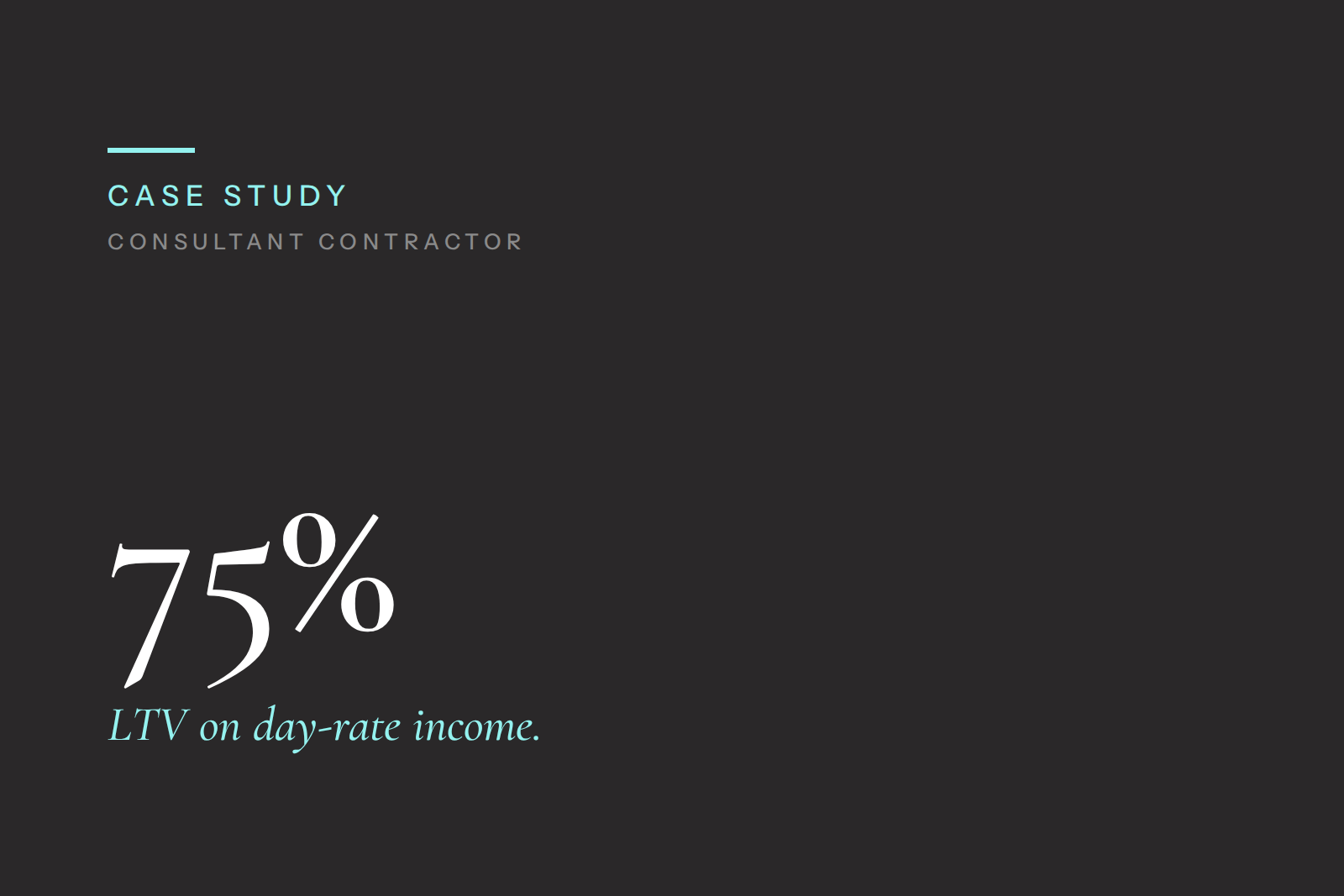
C A S E S T U D I E SHow we've helped contractor clients


A R T I C L E SArticles on contractor mortgages




W H Y U S E A B R O K E RHow Kite Mortgages Helps Day Rate Contractors
Here's what happens when you get in touch. We'll ask for your day rate, your contracting history, how you're set up (Ltd company, umbrella, or PAYE), and your target property value or remortgage amount. Within the same day, we'll come back to you with three things: which assessment route — day rate annualisation or company accounts — gives you the higher figure, which lenders to approach based on your specific profile, and what your indicative borrowing looks like under each option.
From there, we handle everything. We gather documents upfront, build the contract timeline, write the gap explanations if needed, and submit a clean application with everything attached. No back-and-forth with underwriters, no missing paperwork, no delays.
Our fees are fixed and depend only on the complexity of your case, not on the size of the loan: £750 for standard cases and £1,250 for specialist cases, payable in two stages, part on receipt of your mortgage offer and the balance on completion. We also receive a commission from the lender. We will confirm which fee applies in the first call, in writing, before any work begins. Full details are on our fees page.