
Investment Banking Associate Secures £930k Mortgage on £1.1m First Home at 6x Base Salary, Sign-On Bonus Excluded
An associate who had moved between investment banks five months earlier wanted to buy her first home before her first bonus at the new bank was paid. Her £60,000 sign-on bonus and a guaranteed first-year bonus of £90,000 did not count towards borrowing: lenders on our panel generally treat a sign-on payment as a one-off rather than as income, and a guaranteed bonus counts once it has been received. The case was built on her £155,000 base salary alone, and because the base was the floor of what she would earn, she chose to borrow at the top of the loan-to-income tiers on our panel: £930,000 at 6 times income, placed with a high street lender whose 6 times tier applies to employed applicants above an income floor at up to 85% loan to value.
Client Snapshot
£1,100,000
Purchase price
£930,000
Mortgage amount
Just under 85%
Loan to Value (LTV)
Associate in the mergers and acquisitions (M&A) team of a US investment bank in London; joined five months before the application, after four years at a European bank in London from analyst to associate · Three-bedroom Victorian terrace house, Earlsfield, South West London · £170,000 deposit · Capital and interest, three-year fixed rate, 30-year term
Key constraint
None of the bonus figures was usable. The sign-on is a one-off payment, the guaranteed bonus had not yet been paid, and the previous bank's bonus history generally does not carry to a new employer. Assessed income was the base salary, and at a standard multiple, or even at 5.5 times, that fell short of the loan
Context
The move between banks came first. After four years at a European bank in London, the client, an M&A associate in her late twenties, accepted an offer from a US bank in the spring: a £155,000 base, a £60,000 sign-on bonus paid in her first month, and a first-year bonus guaranteed at a minimum of £90,000 in the offer letter, payable the following spring. The sign-on was there to cover what she gave up by leaving, including a deferred award at the old bank that lapsed when she resigned.
The flat came second. She had rented a one-bedroom flat near Clapham Common for three years, and the new role settled the question of where she would be for the next several: London, on a desk that runs through vice president (VP) and beyond. She and her partner, who is in the final year of a doctorate in materials science on a research stipend, started looking on that basis. A three-bedroom Victorian terrace house in Earlsfield, a few streets from the station, came up at £1,100,000. A stipend is not income a lender can assess, so the application went in her sole name. The £170,000 deposit came from savings built through her analyst years, with the sign-on payment making up the balance once it landed.
Her working assumption, before she called us, was that her income for mortgage purposes was £305,000: base, sign-on and guaranteed bonus together. On that figure she had been viewing at £1.3m and above. This is a profile we see often across investment banking →, and the first job was to reset the number.
The Challenge
Three parts of her package looked like income. Lenders on our panel would generally not treat them that way.
The sign-on bonus first. A sign-on is a payment for joining, made once, and in this case repayable if she left within two years. Lenders on our panel generally treat it as a one-off rather than as earnings: it will not be paid again next year, and a clawback clause means it may not be hers to keep. In our experience it is excluded from affordability across the panel. What it can do is sit in the deposit, which is exactly where hers went; our article on using your annual bonus to boost your deposit → covers the mechanics.
The guaranteed bonus second. Bank moves often come with a first-year guarantee, and lenders may treat a guaranteed bonus more favourably than a discretionary one, in some cases counting it in full. The condition is that it has been paid. Until the money is on a payslip it is a promise from an employer she had been with for five months, and lenders on our panel generally work from bonus received rather than bonus promised. Her guarantee was payable the following spring; at the point of application it counted for nothing.
The previous bank's bonus history third. Her P60s showed £55,000 and £70,000 of bonus over the two years before the move. Bonus history generally does not carry between employers: lenders may want to see bonus paid by the current employer, and where two years' history is the criterion the clock restarts with the new bank. The mechanics are set out in our article on how bonuses are calculated in investment banking affordability →
That left £155,000 of base salary. At a standard multiple of 4.49 times, £155,000 supports £695,950. Even at 5.5 times it supports £852,500, and the house needed £930,000 with the deposit she had. Only the top loan-to-income (LTI) tier closed the gap: some lenders on our panel operate a 6 times tier, gated on income above a floor, often £75,000 for employed applicants, on LTV, generally 85% and in one or two cases 90%, and on repayment type, capital and interest only. Some 6 times tiers are restricted to first-time buyers, some to customers who hold a banking relationship, and some are open to any employed applicant who clears the income floor. At £155,000 she cleared every income floor we checked. Interest-only was not in play at this LTV in any case, with straight interest-only ceilings on our panel generally sitting below 85%.
There was a second route, which was to wait. If she held off until the guaranteed bonus was paid in the spring, some lenders may recognise a first received bonus, at 50% for cautious lenders and potentially in full where a guarantee is evidenced, taking assessed income to somewhere between £200,000 and £245,000 on the same base, which at a standard 4.49 times supports £898,000 to £1,100,050. She would also have been nine months further into the new job and past probation. Against that: nine more months of rent, a seller who wanted to sell now, and a purchase she could reach now, on base, at the top tier. Waiting for the bonus at a standard multiple and borrowing now at 6 times base arrive at roughly the same figure; the difference is nine months. Our guide to bonus income mortgages → covers the treatments in more detail.

Director and Mortgage Adviser
Specialist mortgage broker for City professionals. David works with investment banking associates and vice presidents buying their first homes, structuring purchases around base salary, bonus timing and the parts of a package lenders may not count.
Lender Strategy
The case was built on the salary and nothing else. That is the income hierarchy in practice: start with the simplest income and add layers only where they are needed and usable. Here none of the layers was usable, and adding them to the application would have invited questions without adding a pound of borrowing. The base salary was contractual, monthly and evidenced by five payslips at the new bank plus the offer letter, and at £155,000 it sat inside the income band for the enhanced LTI tiers on our panel.
The client's own view settled the multiple. She knew the £155,000 was the floor of what she would earn, with a £90,000 guarantee already in writing behind it, so she was comfortable borrowing at the top of what the base alone could support rather than sizing the purchase to a standard multiple. Six times £155,000 is £930,000. Set against the £245,000 she was contracted to receive in her first year, that is roughly 3.8 times, and against her own £305,000 count of the package, close to 3 times. The lender's calculation sees only the 6.
From the lenders whose 6 times tiers apply at just under 85% LTV on a purchase, we selected a high street lender whose tier is open to employed applicants above an income floor, on capital and interest, with no first-time-buyer restriction and no requirement to hold an account. Affordability was tested in full on the base alone, with the monthly payment sized to it, and the loan passed the lender's assessment at the tier's ceiling. The bonuses, when they arrive, are overpayment money.
Worked comparison, on the same salary
Investment banking associate, £155,000 base, sign-on and guaranteed bonus excluded
The same base salary, assessed at three multiples.
- Base salary
- £155,000
- Sign-on bonus
- £60,000, paid in her first month, repayable if she leaves within two years; excluded from income, used in the deposit
- Guaranteed first-year bonus
- £90,000 minimum in the offer letter, payable the following spring; not yet paid, so excluded
- Previous bank's bonus history
- £55,000 and £70,000 over the two years before the move; does not carry to the new employer
- Purchase
- £1,100,000 with a £170,000 deposit
- Requirement
- £930,000 on capital and interest at just under 85% Loan to Value (LTV)
£155,000 base at 4.49 times = £695,950.
£155,000 base at 5.5 times = £852,500, £77,500 short of the loan.
£155,000 base at 6 times = £930,000.
What the client had assumed: base, sign-on and guaranteed bonus of £305,000 at 4.49 times = £1,369,450, a basis we have not seen a lender use.
Please note: These figures are for illustrative purposes only. The actual amount you can borrow will depend upon your personal circumstances, credit profile, LTV, the lender's individual criteria and a full affordability assessment.
The employment position needed care. She was five months into the new role, inside a six-month probation period, with no bonus paid there. The lender's criteria can accept applicants in a probation period where the role is permanent and employment has been continuous, both of which applied. The offer letter, a letter from the bank's human resources (HR) team confirming her start date, role and salary, and the P60s from the previous bank established four years of continuous employment across the two firms.
Timing was built into the product rather than delayed for it. A three-year fixed rate ends when she will have three bonus rounds paid by the current bank, a full track record even on the two-year test cautious lenders may apply, at a point where she is likely to be a VP. The mortgage can then be reviewed on the whole package. In the meantime the product's annual overpayment allowance, 10% of the balance, is more than her guaranteed bonus. If she uses it, the balance at the end of the fix is a smaller multiple of a larger, fully evidenced income.
The application went in with five payslips from the new bank and the offer letter; the HR letter confirming role, start date and permanent status; two years of P60s from the previous bank; three months of bank statements showing the deposit, including the sign-on payment landing; and a short covering note stating that the sign-on and the guaranteed bonus were excluded from the income case by design, and that affordability rested on base salary alone.
The Result
The Result
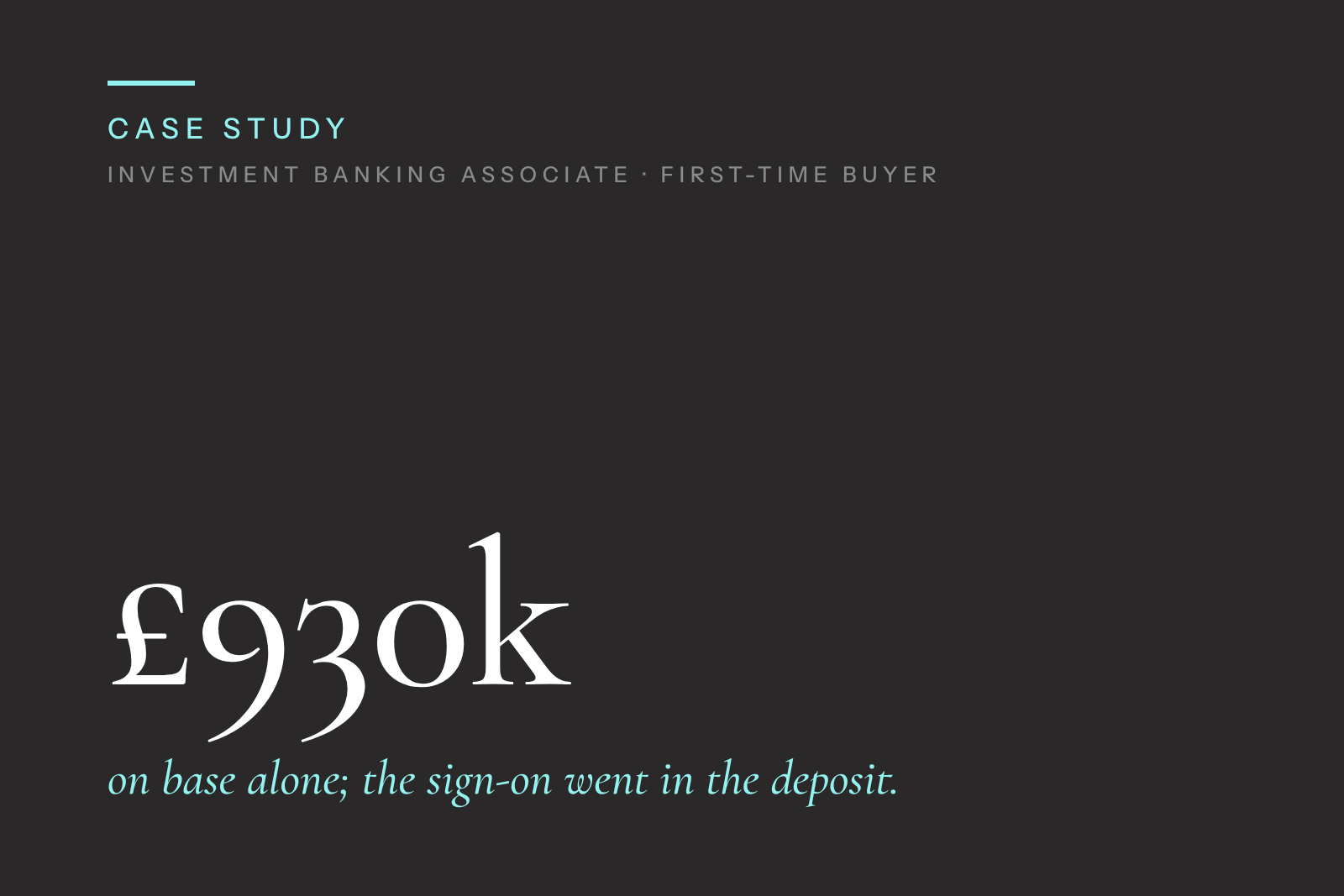
A £930,000 capital-and-interest mortgage agreed at just under 85% LTV, at 6 times base salary alone
£930,000
Loan (capital and interest, three-year fix, 30-year term)
Just under 85%
LTV
£155,000
Assessed income (base salary; sign-on and guaranteed bonus excluded)
6×
Income multiple
Decision in Principle (DIP)
2 working days after the first call
Offer
4 weeks from the first conversation
Exchange and completion
7 weeks after offer
First overpayment
Pencilled in for the spring, from the guaranteed bonus
A £930,000 capital-and-interest mortgage was agreed at just under 85% LTV on a three-year fixed rate over a 30-year term, at 6 times the £155,000 base salary, priced within the standard high street range for lending at this LTV. A Decision in Principle (DIP) was issued two working days after the first call; the full application went in on day six once the HR letter arrived, and the offer followed 14 working days later, four weeks from the first conversation. The house was empty, so exchange and completion ran seven weeks after offer. The first overpayment is pencilled in for the spring, from the guaranteed bonus.
Why This Matters for Similar Clients
Associates who have just moved banks tend to add up the whole package and budget on it. The sign-on and the guarantee are real money, and both have a job in a purchase: the sign-on as deposit, the guarantee as overpayment once paid. Neither is income until a lender can see it on a payslip. What counts on day one is base salary, and at associate and VP pay levels that alone can reach 5 to 5.5 times at 85% LTV with some lenders, potentially up to 6 times. For a borrower whose base is the floor of her income, the top tier is often the right place to be: 6 times what the lender sees can be 3 times what she is paid. The decision is whether to buy now on base or wait for the bonus record to build, and that is a timing question. For how bonus treatment differs from one lender to the next, see our article on how investment banking bonuses are assessed across different lenders →
What We Can Do for You
- Tell you before you view what your base salary alone may support, and which lenders on our panel operate a 6 times tier at your deposit level and employment status
- Set out what a sign-on payment, a guaranteed first-year bonus and a previous employer's bonus history do and do not add, and when each may start to count
- Compare buying now on base with waiting for the first bonus to be paid, with the arithmetic for both
- Package a probation-period application from a new employer: offer letter, HR confirmation and continuous-employment evidence assembled before submission
FAQs
Generally not. In our experience lenders on our panel treat a sign-on payment as a one-off rather than as income, and a clawback clause reinforces that view. The cash itself can be used towards a deposit.
Potentially, once it has been paid. Lenders may treat a guaranteed bonus more favourably than a discretionary one, but they work from what has been received, so a guarantee in an offer letter generally does not count until it appears on a payslip.
Generally not in its own right. Lenders may want to see bonus paid by your current employer, and where two years' history is required the record starts again with the new bank.
Potentially. Some lenders accept applicants in a probation period where the role is permanent and employment has been continuous, evidenced by the offer letter, an HR letter and the previous employer's records.
It depends on the lender's loan-to-income tier. At a standard 4.49 times, £155,000 of base supports around £695,950; some lenders on our panel operate tiers of 5.5 times and potentially up to 6 times (£930,000 on the same base), subject to income floors, LTV limits, capital-and-interest borrowing and a full affordability assessment.
Related Case Studies



YOUR HOME MAY BE REPOSESSED IF YOU DON’T KEEP UP REPAYMENTS ON YOUR MORTGAGE
Kite Mortgages is a trading style of Kite Financial Ltd which is an appointed representative of The Openwork Partnership, a trading style of Openwork Limited which is authorised and regulated by the Financial Conduct Authority.
Approved by The Openwork Partnership on 17/09/2026
This client scenario is an amalgamation of cases we have handled. Details have been combined and adjusted to protect client confidentiality, and it does not describe a single client or transaction.